
Mosquitoes
Public Health Importance
Feeding and disease transmission
Male mosquitoes exclusively feed on plant nectar and juices. Female mosquitoes also consume plant materials but require blood meals before laying eggs. Disease transmission occurs when infected mosquitoes feed on healthy individuals.
For example, malaria parasites move from the gut of an infected female Anopheles mosquito to humans during feeding. Similarly, dengue and yellow fever viruses enter mosquitoes when they feed on infected individuals, then spread to healthy hosts through saliva during subsequent blood meals.
Mosquito life cycle
Stage 1: Eggs
Female mosquitoes lay eggs in standing water, which hatch into larvae within days depending on temperature and conditions.
Stage 2: Larvae
Known as “wrigglers” due to their jerky swimming motion, larvae feed on organic matter and occasionally other mosquito larvae.
Stage 3: Pupae
Called “tumblers,” pupae are mobile and swim in water. Both larvae and pupae must surface regularly to breathe air.
Stage 4: Adults
Adult mosquitoes emerge from pupae and mate shortly after to continue the reproductive cycle in 2-3 days.
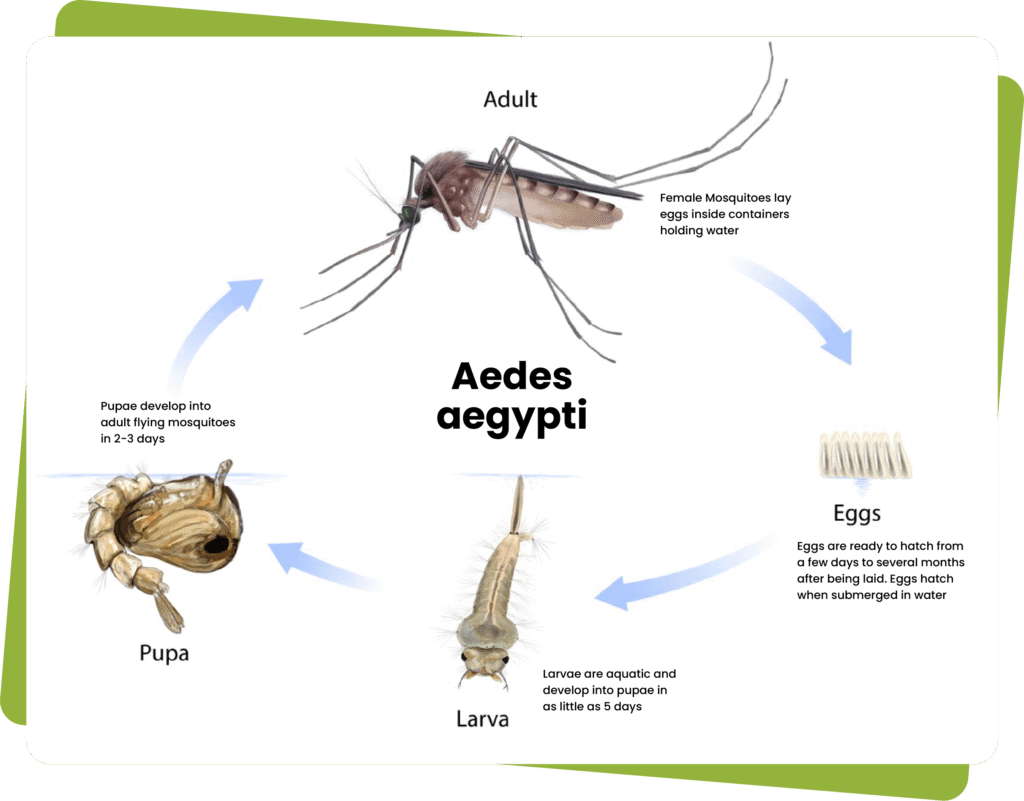
Lifecycle
Why do people attract mosquitoes
- sweat odors
- Carbon dioxide
- octenol
- lactic acid
- body heat
- Movement
Three Mosquito Genera
Aedes
Aedes mosquitoes have white markings on their black thorax and hold their bodies parallel to the surface when resting. Though Aedes mosquitoes lay eggs in rainwater or marshland, they also prefer domestic environments such as empty vessels and containers, flower vases, drain trays below potted plants, water coolers, and tires to lay their eggs. Aedes mosquitoes spread dengue, encephalitis, yellow fever, and Zika fever.
Anopheles
Anopheles mosquitoes have spots on their wings and prefer water having aquatic plants to lay their eggs. They rest at an angle to the water surface with their body parts in a straight line. Anopheles mosquitoes spread encephalitis, filariasis, and malaria.
Culex
A Culex mosquito rests on a surface by keeping its body parallel to the surface. Female Culex mosquitoes prefer fresh or impure water to lay their eggs and spread encephalitis and filariasis.
Integrated Mosquito Management
While pest management professionals (PMPs) use larvicidal pesticides to control mosquito larvae, forming oil films on water surfaces prevents breathing by mosquito larvae and kills them. Indoor and outdoor fogging, either cold or thermal fogging with synthetic pyrethroid pesticides, controls adult mosquitoes. PMPs apply synthetic pyrethroids on walls and other indoor surfaces as an indoor residual spray (IRS) for long-lasting protection against mosquitoes resting on such treated surfaces.
Personal protection from mosquitoes
- Use of long-sleeved clothing, covering ankles with footwear
- using mosquito repellents in the air or on exposed body parts
- screening windows and doors
- limiting movement during dusk and dawn for minimizing attraction to mosquitoes
- use of mosquito treated bed nets are common

Mosquito traps
While the New Jersey Light trap attracts multiple mosquito species through light, the CDC light traps use light and carbon dioxide to attract and trap mosquitoes.
Gravitraps are no longer just surveillance tools to monitor mosquito presence and population, but like in the AedesX Smart Gravitraps, an important smart technology tool for control of Aedes mosquitoes.
Gravitraps
These are traps whose design attracts and traps female mosquitoes to lay their eggs. The prefix ‘gravi’ in gravitrap stands for gravid or egg carrying or pregnant female mosquito.
Since the past three decades, traps that attract, kill, or limit mosquitoes have emerged as an effective Integrated Mosquito Management tool. Early gravitraps in the United States used stagnant water in organic matter like grass or hay to mimic stagnant natural water to attract mosquitoes. In addition, the early gravitraps used battery-run fans to push mosquitoes into a collection chamber.
Though gravitraps do not control mosquitoes, they effectively minimize pesticide use to curb mosquito populations.
Some gravitraps depend on pesticides to kill mosquitoes, whereas others like the AedesX Smart Gravitrap only kill the larvae and prevent an increase in the mosquito population.
- Ovitraps : similar to gravitraps, have a design that encourages female mosquitoes to oviposition or lay eggs in such traps.
- Lethal ovitraps : It attract, trap, and kill female adult mosquitoes using pesticides and prevent reproduction as they stop egg-laying by a female mosquito. The two types of lethal ovitraps include larvidical or those that kill only larvae and adulticidal or those that kill both adults and larvae that emerge from eggs that the female adults laid in the trap.
- Which mosquito species do ovitraps attract : While the gravitraps from the United States attracted Culex tarsalis or Culex pipiens, Ovitraps like AedesX are now available. They are suitable for container breeding mosquitoes like Aedes aegypti or Aedes albopictus. The BG-Sentinel trap from the United States attracts Aedes aegypti or Aedes albopictus by using human scent, octenol, or carbon dioxide and collects them live by a fan.
- Which countries use gravitraps in mosquito management : Starting with the United States, where the country’s military developed and deployed a gravitrap, many countries have successfully adapted gravitraps. While Singapore’s National Environmental Agency (NEA) uses them effectively, others such as Australia, the Philippines, Brazil, and Thailand have also benefitted from gravitrap use. Peru and Bangladesh have also studied gravitrap technology to overcome mosquitoes.