Introduction: A New Climate Demands a New Playbook
June 6 marks World Pest Day 2026, a global observance that arrives at a critical ecological juncture. We are no longer speaking of climate change in the future tense. Around the globe, rising baseline temperatures and volatile weather patterns have directly triggered a surge in pest incidence. Pest life cycles are shortening, pest geographic ranges are expanding, and structural vulnerabilities to pests are intensifying worldwide.
For the professional pest management industry, the reality of pests in a warming world exposes a glaring flaw in conventional, heavily pesticide-reliant systems. Rapid pest reproduction leads to faster chemical resistance, putting Pest Control Operators (PCOs) on an expensive, unsustainable pest-treatment treadmill.
As a long-standing pioneer of non-toxic pest management, Giridhar Pai Associates (GPA) is using this World Pest Day to introduce a fundamental shift in industry philosophy.
We are officially launching a new expansion and focus for IPM: Inspection, Prevention, and Monitoring.
By returning to and elevating these core pest management tenets, we are empowering the pest control industry to transition from a culture of reactive extermination to one of proactive, non-toxic structural defence.
Giridhar Pai Associates New IPM Matrix
The Architecture of the New IPM Framework
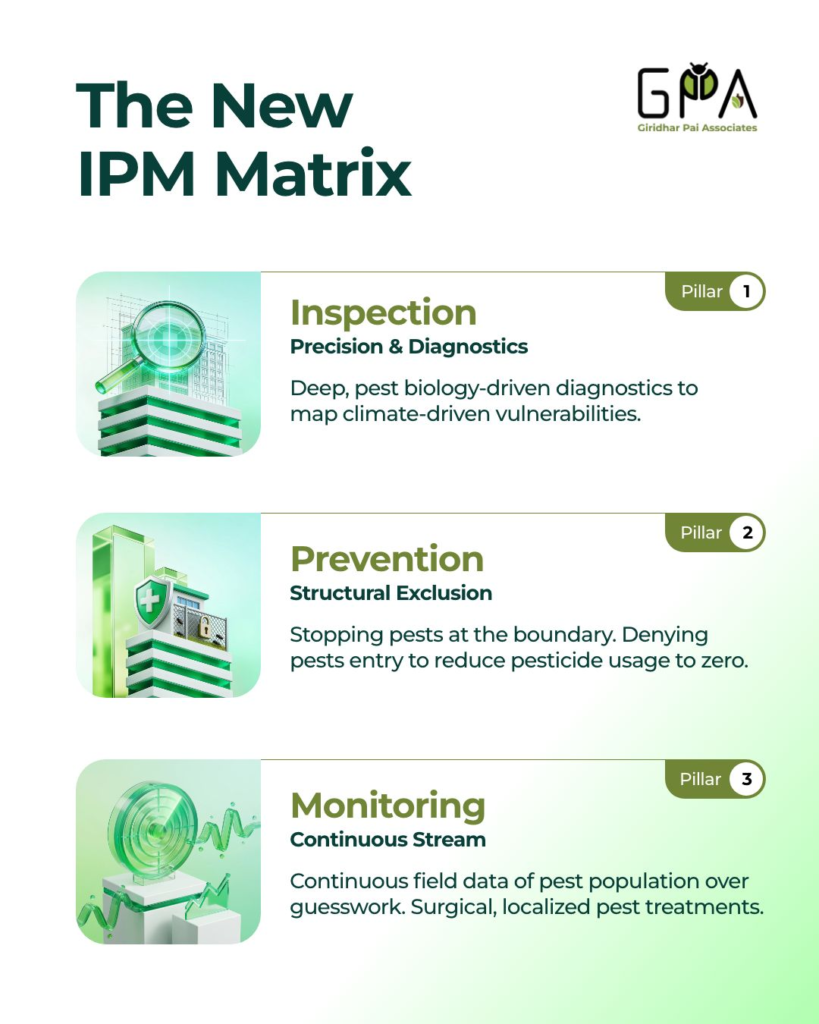
True thought leadership doesn’t simply identify a problem; it provides the structural blueprint to solve it. GPA’s redefined IPM matrix focuses resources where they matter most:
1. Inspection: The Foundation of Precision
Before a tool is deployed, a building must be understood. Inspection under our framework involves deep, pest-biology-driven diagnostics to detect pests and the conditions that suit them. PCOs must look at structures through the lens of changing pest behaviour, locating pest harbourage, micro-habitats, and pest vulnerabilities caused by shifting weather patterns.
2. Prevention: Denying Entry and Habitats
PCOs apply chemical pesticides often because structural exclusion failed or was not attempted. The new IPM prioritises physical barriers. If a pest cannot enter a food processing facility, commercial kitchen, or residential property, the need for pesticide application drops to zero. Pest prevention is the ultimate form of sustainable pest management and is the second cornerstone of GPA’s IPM approach.
3. Monitoring: Data Over Guesswork
With pest populations fluctuating rapidly due to global warming, intermittent checks are no longer sufficient. Continuous pest monitoring provides a constant stream of field data to inform action to address the infestation. Pest monitoring data tells the PCO exactly what pest species are present, in what density, and precisely where, allowing for surgical, localised interventions. Such precise pest treatments are likely to be most effective at controlling pests.
Giridhar Pai Associates – From IPM Philosophy to the Field
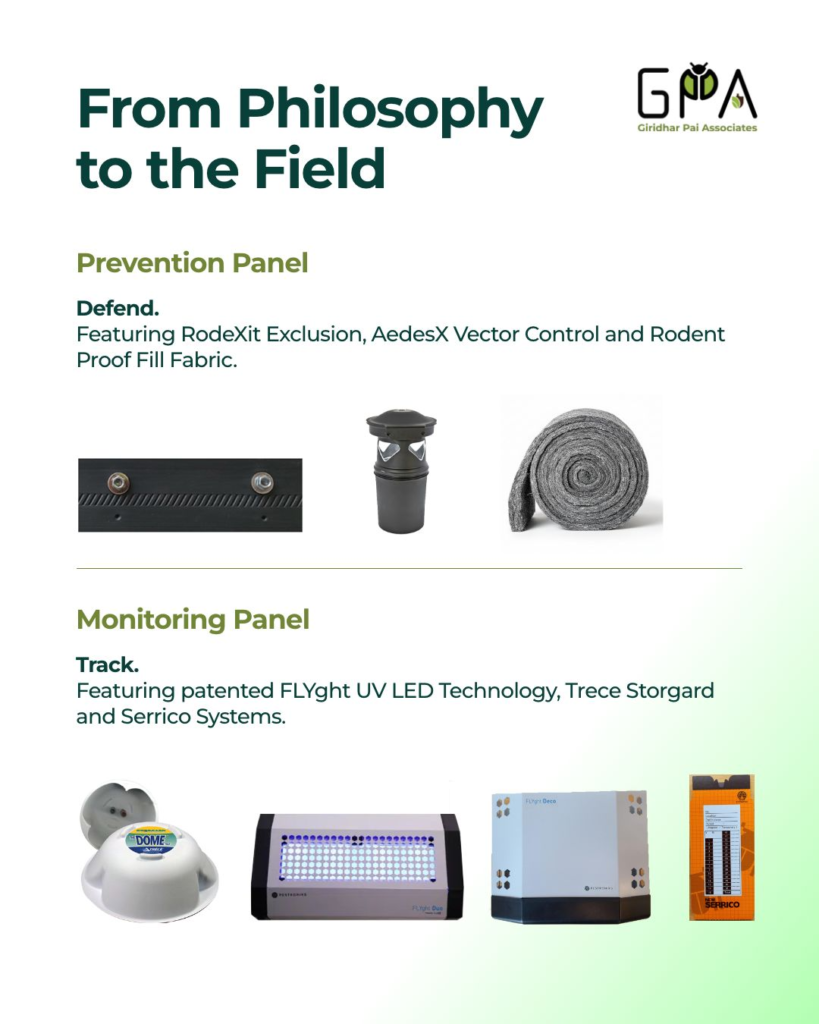
From Philosophy to the Field: GPA’s Non-Toxic Product Ecosystem
A philosophy is only as powerful as the tools that execute it. Over the last six years, from 2020 to 2026, GPA has curated a world-class portfolio of international and domestic brands designed to make this non-toxic IPM framework fully operational for PCOs, reducing their operational costs while boosting their cross-selling revenue.
| IPM Pillar | Operational Objective | GPA Non-toxic Solutions |
| Prevention | Permanent structural exclusion and non-toxic vector suppression. | RodeXit All-In-One Rodent-Proofing Strips, Rodent Proof Fill Fabric, and the pesticide-free AedesX Smart Gravitrap for Aedes mosquito control. |
| Monitoring | Early detection and precise population mapping. | Trece Storgard Insect Monitoring Systems, Serrico Traps, and SPP Diamond Traps. |
| Inspection | Eco-friendly, continuous flying insect monitors. | FLYght UV LED Insect Light Traps (utilising patented bio-Visual Enhancer VE+ technology), featuring the heavy-duty FLYght One, FLYght Duo, and the aesthetically seamless FLYght Deco for commercial spaces. |
By utilising these non-toxic tools, our reseller partners move away from selling temporary pesticide sprays and begin selling permanent, high-margin, asset-based pest prevention programs to the food, pharmaceutical, and hospitality sectors.
The Pioneering Spirit: Building a Knowledge Ecosystem
GPA has never been just a product distributor but also a creator of pest management ecosystems for specific pest categories. Our journey, inspired by the ecological principles of organic farming, is driven by a desire to raise the collective intelligence of the pest management industry.
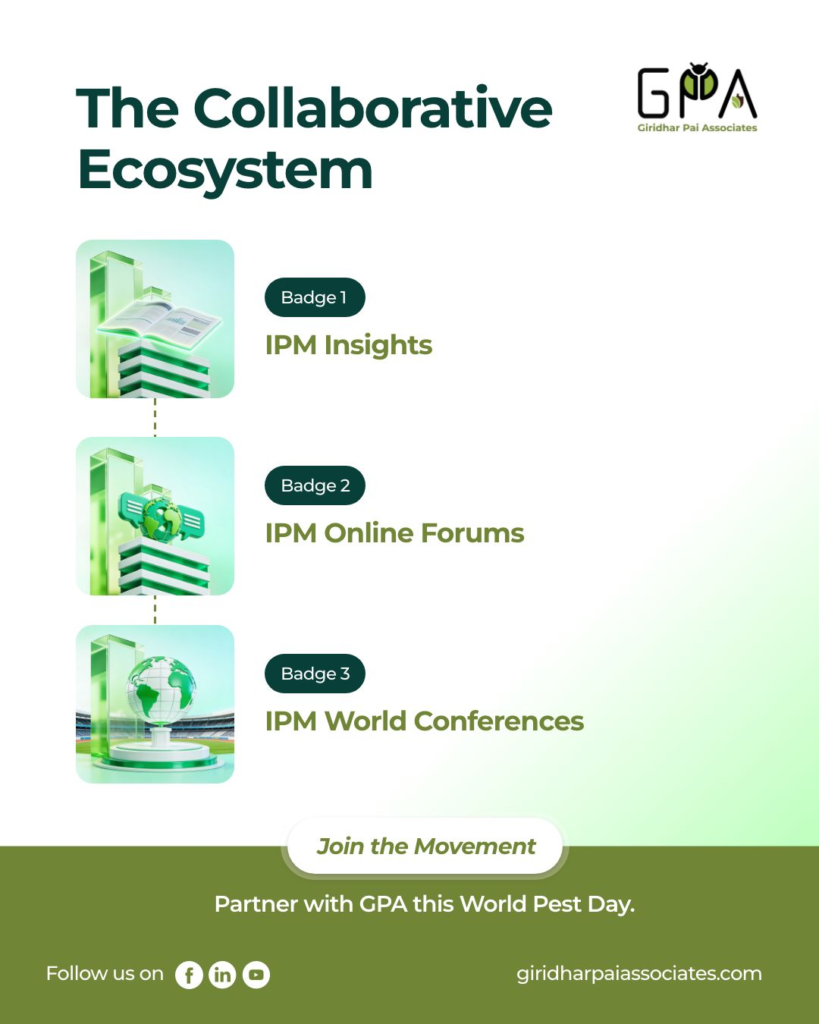
To ensure the new IPM framework is adopted successfully, we are establishing a comprehensive, multi-tiered knowledge infrastructure to support our current partners and welcome new global collaborators:
- IPM Insights: A digital intelligence stream published by the GPA Pest Management Academy, offering deep dives into climate-driven pest trends, biology updates, and non-toxic application strategies.
- IPM Online Forums: An interactive, peer-to-peer digital ecosystem where PCOs, food safety managers, and environmental scientists can collaborate, share real-time field data, and solve complex pest infestation challenges collectively.
- IPM World Conferences: A series of premier global events uniting international manufacturing partners, research scientists, and forward-thinking pest control operators to showcase the next generation of non-toxic technologies.
Giridhar Pai Associates Collaborative IPM Ecosystem
A Call to Collaboration on World Pest Day
The challenges of 2026 require collective bravery. We extend our deepest gratitude to our current partners who have helped us establish sustainable pest management across India and the broader Asian market.
To potential collaborators, whether you are a global manufacturer of innovative non-toxic pest management tools or a regional Asian PCO ready to upgrade your service model, GPA opens its doors to you.
Let us honour World Pest Day not by looking back at what pest control used to be, but by forging what it must become. Together, through Inspection, Prevention, and Monitoring, we can secure our structures, protect our food supply, and safeguard our planet.
To learn more about implementing the new IPM framework in your facility or to join our partner distribution network, visit the Giridhar Pai Associates Website today.
Watch this FLYght Deco Launch Video to see how GPA brings its design-forward, non-toxic monitoring philosophy to life for commercial spaces.