
The Food Safety and Standards Authority of India (FSSAI), in partnership with State Food and Drug Administrations (FDAs), has launched an unprecedented “zero-tolerance” enforcement campaign targeting Food Business Operators (FBOs) nationwide.
FSSAI’s aggressive drive, in partnership with FDAs, marks a significant shift in India’s food safety landscape, moving FBOs from basic licence compliance to demonstrable, verifiable food safety, hygiene, and labelling standards.
FSSAI and FDA Enforcement Actions: The Numbers
Between April and August 2026, central and state agencies conducted over 705,000 inspections, raided 13,203 premises, issued more than 33,000 notices, suspended 677 licences, and arrested over 600 individuals.
Maharashtra (MH)’s FDA has led high-profile enforcement, exposing widespread non-compliance across restaurants, quick commerce and e-commerce warehouses, canteens, hotels, manufacturing plants, and more. Public support for MH FDA’s action against FBOs has been strong, with citizens actively reporting food safety violations at restaurants.
Given that the Indian Safety and Standards (Licensing and Registration of Food Businesses) Regulations, 2011, have been in force for over fifteen years, FBOs are expected to be fully aware of, and compliant with, the law.
Restaurants in the Spotlight: Pest Issues Dominate
Restaurants have become a frequent source of food safety violations, with pest infestations, especially cockroaches, flies, and rodents, the most common and persistent issue across the country.
The good news: preventing these pests doesn’t require major investment.
By implementing Giridhar Pai Associates (GPA)’s Integrated Pest Management (IPM) formula: Inspect, Prevent, and Monitor, restaurants can avoid non-compliance. Importantly, the likely practice of using household insecticides inside food premises for pest control is discouraged, as improper use can create new violations by contaminating food with pesticide residues.
Why Pesticide Sprays Aren’t the Solution
Commercial kitchens, storerooms, and dining spaces provide warmth, moisture, and organic residue, which are ideal conditions for tropical pests. Relying only on pesticide sprays risks food contamination and fails to address the root causes of infestations. Sustainable food safety relies on non-toxic IPM, focused on routine inspection, prevention, and monitoring.
The “Big Three” Pests in Indian Restaurants
1. German Cockroach (Blattella germanica)
- Biology: Small (12–15 mm), light brown with two dark stripes on the thorax. Females carry egg capsules with 30–48 eggs; the life cycle completes in under 60 days in warm conditions, allowing rapid population growth.
- Behaviour: Nocturnal and “thigmotactic” (prefers tight cracks/crevices), congregates near heat, moisture, and food debris (e.g., under refrigerators, dishwashers, inside switchboards).
- Risks: Spread foodborne pathogens (Salmonella, E. coli), trigger asthma, and can prompt regulatory shutdowns.
2. Commensal Rodents
- Roof Rat (Rattus rattus): Slender, large ears, long tail, an excellent climber, prefers roofs and ceilings.
- Norway Rat (Rattus norvegicus): Stockier, smaller ears, blunt muzzle, burrows at ground level.
- House Mouse (Mus musculus): Small (15–20g), can squeeze through 6 mm gaps, highly reproductive.
- Behaviour: Rodents are wary of new objects, gnaw on wood/wiring/packaging, and forage at different building levels.
- Risks: Contaminate dry goods with urine, faeces, and hair; create fire hazards by chewing cables; spread diseases like leptospirosis.
3. Housefly (Musca domestica)
- Biology: Adult has four dark thoracic stripes; females lay up to 500 eggs in decaying matter. In India’s warm climate, a generation can complete in just 7–10 days.
- Behaviour: Attracted to fermenting odours and waste; regurgitate digestive enzymes and defecate while feeding, often on food and utensils.
- Risks: Efficient vector for enteric diseases (cholera, shigellosis, food poisoning).
GPA’s IPM: Inspection, Prevention and Monitoring Big Three Pests of Indian Restaurants
Focus areas of Inspection:
German Cockroach: Behind prep tables, rubber door gaskets of refrigerators and chillers, motor compressors, hollow table legs, electrical conduits, under sinks.
Rodents: Gaps around plumbing penetrations in walls, spaces beneath external doors, false ceilings, gnaw marks on grain sacks, dark droppings along baseboards (wall skirting).
Housefly: Wet garbage compactors, open drain gullies, food delivery loading bays, outdoor waste storage, fruit and vegetable peeling stations.
Prevention:
German Cockroach: Seal all expansion joints and tile gaps with food-grade silicone; eliminate standing water; eliminate cardboard box storage; degrease splashbacks and floor drains nightly.
Rodents: Install durable, gnaw-proof rodent seals around external entry doors and shutters; seal pipe gaps with stainless-steel rodent-fill fabric; elevate all dry food storage 15 cm off the floor on wire racks; secure waste bins with tight-fitting lids.
Housefly: Install automated high-velocity air curtains over kitchen entry doors; fit tight mesh screens (minimum 18-mesh) on all open windows/vents; clear wet kitchen waste twice daily; maintain clean, covered outdoor waste bins.
Monitoring:
German Cockroach: Cockroach monitoring traps placed in corners, under equipment legs, and near warm sources to establish baseline population counts.
Rodents: Tamper-resistant, non-toxic mechanical snap traps and multi-catch live traps placed flush along perimeter walls and runway paths; non-toxic cellulosic food bait.
Housefly: Modern, energy-efficient UV LED insect light traps equipped with glue boards (placed 1.5–2 m high away from competing sunlight and out of direct sight of dining areas); non-toxic fly traps at exterior refuse perimeters.
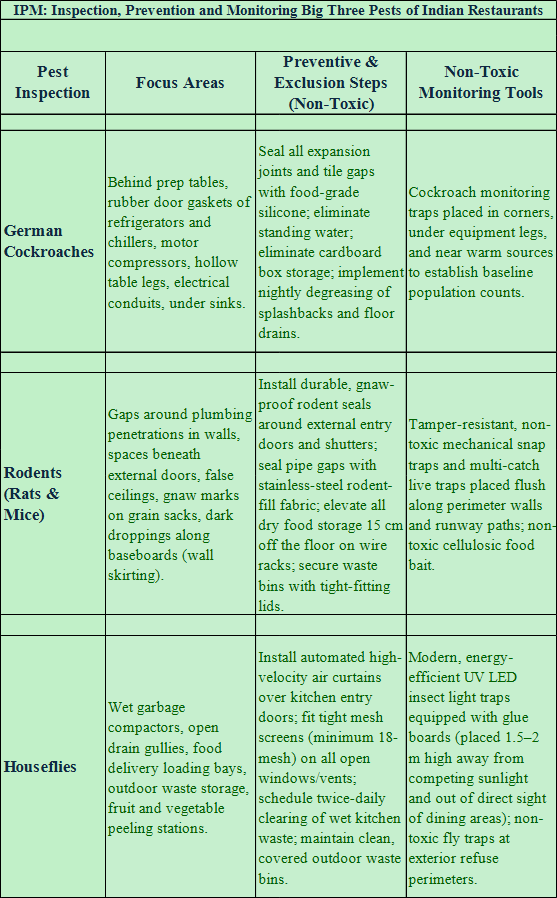
IPM: Inspection, Prevention and Monitoring Big Three Pests of Indian Restaurants
Conclusion
For Indian restaurants, robust pest prevention is now non-negotiable. Adopting non-chemical, IPM-based solutions is the safest and most compliant way forward, protecting food, customers, and restaurant business licences alike by avoiding FDA regulatory action.
As India’s only distributor of pest monitoring and prevention solutions, GPA offers the following products for food-safe and non-toxic cockroach, rodent, and housefly management at restaurants.
- Gumtree Roach Trapp to monitor cockroaches
- RodeXit rodent seal and Rodent Proof Fill Fabric to prevent rodents
- FLYght Duo and FLYght Deco LED fly catchers to monitor flies.
If you are an Indian restaurant owner, contact us to begin your non-toxic pest control journey today, using common sense, inspection, prevention, and monitoring tools to safely control the big three of Indian restaurants: cockroaches, rodents, and houseflies, without pesticides.