
A Stored Product Insect (SPI) monitoring programme is an early-warning Integrated Pest Management (IPM) system designed to detect, track, and locate high-risk stored insect populations inside food processing plants, grain mills, and dry storage warehouses before an active infestation contaminates product lines and the supply chain.
Whether you manage raw commodities like grains, flour, herbs, spices and seeds, or high-value processed goods such as biscuits, pasta, chocolate, spices, and pet food, continuous pheromone monitoring is critical to comply with FSSAI regulations, global food safety standards, and third-party audit and customer requirements.
Common Signs of Stored Product Insect Infestation
Finding live beetles or feeding larvae indicates a mature infestation. However, earlier warning signs often appear across packaging and facility structures:
- Bore holes & micro-perforations in flexible polybags, cardboard cartons, and paper packaging.
- Silk webbing produced by moth larvae along conveyors, bagging equipment, ceiling beams, and pallet corners.
- Frass (insect waste) resembling fine pepper or sawdust gathered at the bottom of racking.
- Powder spills or residues leaking from pinholes in food containers.
- Adult insect activity, such as flying moths around lighting fixtures or crawling beetles on floors, ledges, and pallets.
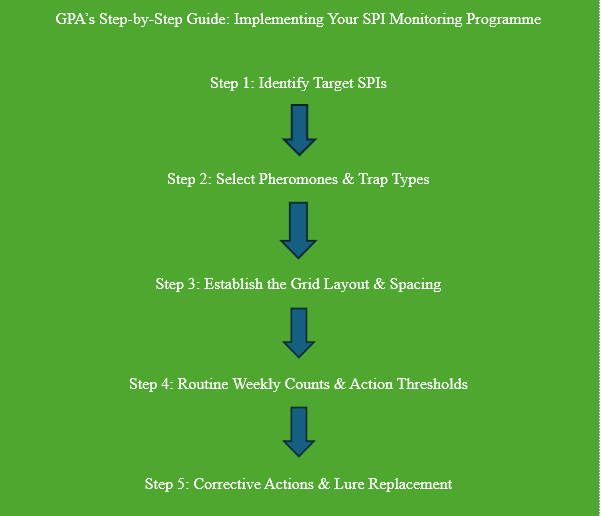
Step 1: Identify Your Primary SPI Species
Accurate species-level identification determines the exact SPI pheromone lure needed to start your pheromone trapping programme. Use physical magnification, diagnostic guides, or pest specialist verification to identify target species:
- Beetles: Cigarette Beetle (Lasioderma serricorne), Confused Flour Beetle (Tribolium confusum), Red Flour Beetle (Tribolium castaneum), Khapra Beetle (Trogoderma granarium) and Warehouse Beetle (Trogoderma variabile).
- Moths: Almond Moth (Cadra cautella) and Warehouse Moth (Ephestia elutella) (Note: The Indian Meal Moth (Plodia interpunctella is not found in India).
Step 2: Select Traps and Pheromone Lures
Different stored product insects respond to distinct trap designs and chemical signals:
- Crawling Beetles (Flour Beetles, Khapra Beetles): Use pitfall-style traps like Trécé StorGard® Quick Change Dome Traps, which allow beetles to climb in while preventing their escape.
- Flying Moths & Active Beetles: Use glue-based triangular or flat interception traps like Storgard® II and SPP Diamond Trapps.
- Lure Chemistry:
- Sex Pheromones: Female-produced attractants used to lure males over longer distances (e.g., Cigarette Beetle, Khapra Beetle, Almond Moth).
- Aggregation Pheromones: Attractants that draw both males and females, typically operating over shorter distances (e.g., Red and Confused Flour Beetles).
Step 3: Map the Grid and Install Traps
Establish a uniform grid across raw material storage, processing rooms, and finished goods warehouses. Spacing must match the effective attraction radius of each lure type:
Table 1: Pheromone Traps, their spacing and lure types for common stored product insects
| Target Insect | Trap Type | Lure Type | Recommended Grid Spacing |
| Cigarette Beetle (CB) | Quick Change Dome Trap | Sex Pheromone | 15 – 20 meters |
| Khapra / Warehouse Beetle (KB/WB) | Quick Change Dome Trap | Sex Pheromone | 15 – 20 meters |
| Almond Moth (AM) | StorGard II / SPP Diamond Trapp | Sex Pheromone | 15 – 20 meters |
| Flour Beetles (CFB / RFB) | Quick Change Dome Trap | Aggregation Pheromone | 8 – 10 meters |
Placement tip: Place beetle pitfall traps flat on floors along wall-floor junctions, racking bases, and near machinery legs. Hang moth traps at chest-to-eye level (1.5 to 2 meters high) away from strong cross-drafts, open bay doors, and exterior entry points to avoid drawing outside populations indoors.
Step 4: Record Weekly Counts and Define Thresholds
Pheromone traps are qualitative monitoring tools that track population spikes and hot spots, not total control or eradication devices.
- Inspection Frequency: Inspect and count target insects in every trap weekly. During peak summer and monsoon months, or when an infestation is suspected, increase counts to two to three times per week.
- Action Thresholds: Establish an Action Threshold (e.g., >2 to 5 target insects per trap per week, depending on plant sensitivity). Exceeding this baseline must immediately trigger localised inspection rather than automated blanket insecticide spraying or fumigation.
Step 5: Implement Corrective Actions
When trap counts spike in a specific quadrant:
- Pinpoint the Source: Conduct focused physical inspections of nearby pallets, dead spaces inside equipment, spill accumulation under racking, and open ingredient bins.
- Sanitise & Segregate: Deep-clean structural residues, vacuum organic dust, and quarantine infested inventory lots immediately.
- Targeted Treatment: If sanitation fails to curb rising counts, apply targeted spot treatments or schedule structural fumigation as a controlled final measure.
Step 6: Maintain Lure Replacement Cycles
Pheromone lures rely on controlled volatile release matrices that degrade over time:
- Replace standard lures every 6 to 8 weeks (or strictly per manufacturer instructions).
- Replace glue boards (StorGard II, SPP Diamond Trapps) simultaneously or sooner if surfaces become coated with food dust or insect debris.
- Maintain a routine, year-round schedule. Tropical and subtropical climates support continuous breeding cycles, making seasonal-only monitoring inadequate.
Build Your SPI Monitoring Program with Giridhar Pai Associates
Proper insect monitoring protects brand equity, cuts unnecessary fumigation expenses, and satisfies stringent FSSAI, AIB, BRCGS, and ISO food safety and customer audits.
Giridhar Pai Associates (GPA) supplies Trécé StorGard® Insect Monitoring Systems, Quick Change Dome and Storgard II Traps, and species-specific pheromone lures across India. GPA’s technical team helps food quality and safety managers and pest management professionals (PMPs) design facility-wide monitoring grids, select multi-species attractants, and set action thresholds tailored to dry food supply chains.
Contact us to start your SPI pheromone trap monitoring programme and maintain it year-round to assess SPI risk and manage it effectively by understanding the target pest population and initiating required corrective action based on pheromone trap counts.