
Modern dry pet food formulations are nutritional powerhouses packed with animal proteins, fats, bone meal, and savoury oils. While these nutrient-dense ingredients keep pets thriving, they also create an irresistible target for specialised stored-product pests.
Among these threats, the Red-legged Ham Beetle (Necrobia rufipes), commonly abbreviated as RLHB, has emerged as one of the most persistent and destructive pests confronting pet food manufacturing plants, processing lines, and distribution warehouses.
Unlike common grain beetles that thrive on simple starches, RLHB actively hunts high-protein, lipid-rich matrices. Because commercial pheromone traps often struggle to outcompete the potent aroma of bulk pet food ingredients, understanding the beetle’s biology and adopting a strict, multi-barrier Integrated Pest Management (IPM) program is essential for managing the RLHB effectively.
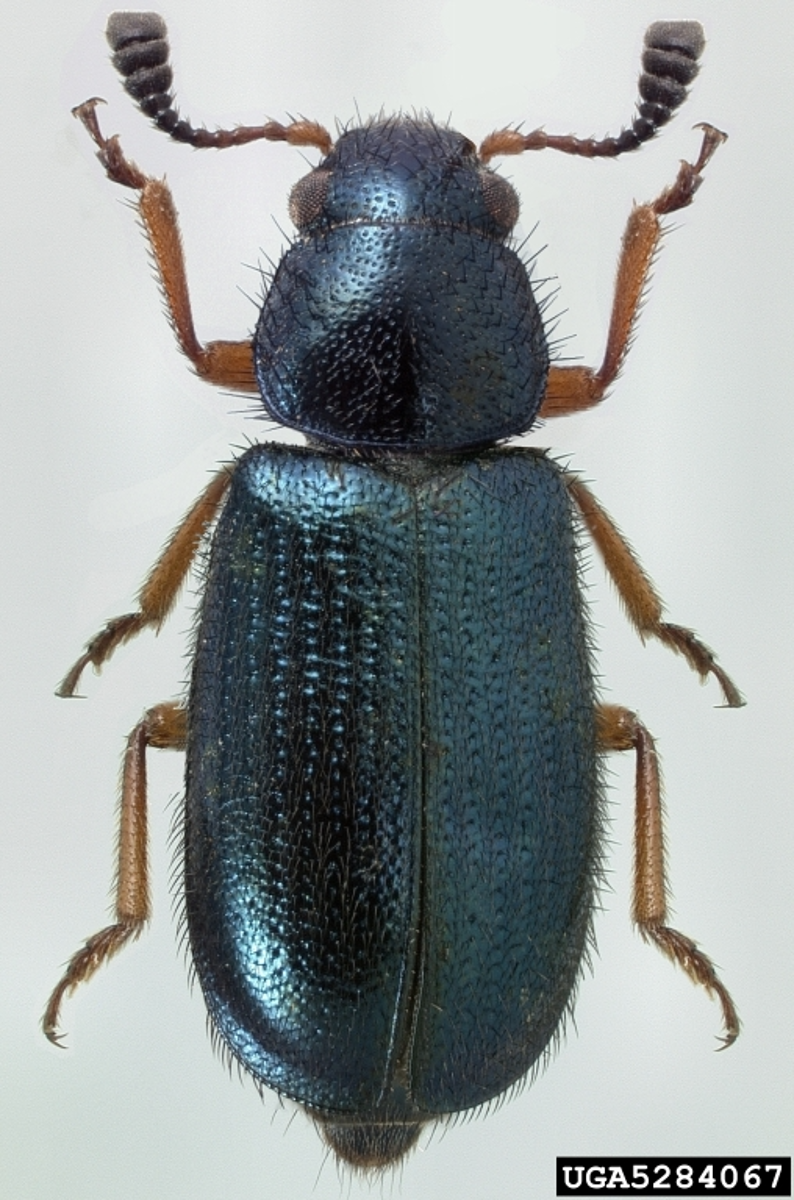
Adult Necrobia rufipes, red legged ham beetle
Image credit: Michael C. Thomas, Florida Department of Agriculture and Consumer Services, Bugwood.org
1. Biology and Distinct Morphology
Necrobia rufipes belongs to the family Cleridae (checkered beetles). Unlike dull, brown pantry beetles such as flour or grain beetles, the adult RLHB has a distinctive appearance:
- Adult Appearance: Measuring roughly 3.5 to 7 mm in length, the beetle features a shiny, metallic blue-green body contrasted by vibrant reddish-orange legs and antennae bases. The antennae end in distinctive, dark, three-segmented clubs.
- Larval Characteristics: Mature larvae grow up to 10 mm long with an off-white to purplish-grey body, a dark reddish-brown head capsule, and two distinct upturned spines (urogomphi) at the rear of the abdomen.
- Mobility & Senses: Adults are swift runners and active fliers, particularly in warm conditions. They are photophobic (light-avoidant) by habit and spend most of their time burrowed inside food products, processing equipment crevices, pallet bases, and dark storage corners.
2. Life Cycle and Environmental Thresholds
The RLHB undergoes complete metamorphosis (holometabolous development: egg, larva, pupa, adult), with developmental speed heavily dictated by temperature and relative humidity:
- Egg Stage: Adult females deposit clusters of small, cylindrical white eggs (resembling tiny grains of rice) into tight cracks, seams of packaging, or directly within the food substrate. A single female can lay between 100 and 3,000 eggs across her lifespan. In warm facilities, eggs hatch in 4 to 5 days.
- Larval Stage: The larval stage is the most destructive phase. Larvae actively tunnel through dry pet food, grinding kibble into powdery frass. Depending on ambient heat and nutrient availability, larvae undergo 3 to 4 moults over 20 to 50 days (though cooler conditions can extend this to more than 100 days). Larval development halts below approximately 22°C (71.6°F).
- Pupal Stage: Once fully grown, the larva seeks out a dry, secluded void, seam, or pallet joint. It secretes a frothy white substance from its mouthparts that hardens into a dense, papery silken cocoon, often incorporating kibble dust for camouflage. Adults emerge after 6 to 14 days.
- Adult Lifespan: Emerging adults harden within days and begin reproducing. Adults can survive from 6 to 14 months, allowing overlapping generations to build up rapidly in unmonitored storage environments.
3. The Double-Edged Nature: Scavenger and Predator
The RLHB possesses an unusual ecological profile compared to standard stored-product pests:
- Nutritional Opportunist: It targets high-fat, high-protein matrices: animal meal, rendering by-products, tallow, dried poultry meal, liver digest, and completed kibble.
- Facultative Predator & Cannibal: In addition to consuming pet food, RLHB adults and larvae are predatory. They actively hunt and devour the larvae, pupae, and eggs of other stored-product insects (such as flour beetles, dermestids, and moths). When food is scarce, or local populations become dense, they readily cannibalise their own eggs and pupae.
- The “Trap Competition” Challenge: Standard insect monitoring often relies on food attractants or synthetic kairomone/pheromone lures. However, because commercial pet food manufacturing areas are saturated with the rich scent of meat meals and fat coatings, traditional lures often get outcompeted by the food’s ambient aroma. This makes visual inspections and sanitation-focused monitoring far more critical.
Key Steps for Pet Food Facilities to Exclude and Control RLHB
Preventing RLHB infestations requires a systematic approach across incoming ingredients, manufacturing, and downstream distribution:
| Control Area | Key Operational Actions |
| Ingredient Reception & Quarantine | Inspect bulk incoming raw materials (rendered animal meals, bone meal, marine powders) before binning. Probe for heat buildup, frass, or live larvae. Isolate rejected shipments immediately to avoid cross-dock contamination. |
| Equipment Sanitation & Design | Eliminate “dead zones” in processing lines, bucket elevators, screw conveyors, and bagging bins where meat meal and fat residues accumulate. Implement routine deep-cleaning cycles using industrial vacuums rather than compressed air, which disperses dust into structural joints. |
| Packaging Integrity | Transition to multi-wall packaging with puncture-resistant barrier films. RLHBs can chew through thin cardboard and unlined paper folds; ensuring hermetic heat seals on finished kibble bags prevents entry during pallet transit. |
| Storage Climate Management | Maintain warehouse temperatures below 20°C (68°F) whenever possible. Keeping storage zones cool and humidity controlled suppresses egg hatching and significantly prolongs or arrests larval development. |
| Structural Exclusion | Seal expansion joints, wall-to-floor junctions, and racking hollows with industrial-grade, non-toxic sealants. Because late-stage larvae crawl away from kibble to pupate inside structural crevices, eliminating physical harbourages breaks the cycle. |
| Strategic Monitoring & IPM | Deploy unbaited glue traps in low-airflow, perimeter zones, especially near ingredient unloading and palletising areas. Pair visual pallet inspections with trap checks to catch early activity before distribution. |
Pet food facilities that rely solely on surface insecticide sprays often see re-infestations because larvae and pupae remain shielded inside machinery voids and bag seams. By combining strict ingredient auditing, aggressive dust removal, temperature management, and sealed packaging, pet food manufacturers can safeguard their product integrity from the production floor to the consumer’s bowl.
Contact GPA for Stored Product Insect Pheromone Monitoring
Giridhar Pai Associates (GPA) is India’s leading supplier of SPI pheromone traps and lures to monitor cigarette, flour and khapra beetles and almond moths in the pet food supply chain. Leading Indian pet food companies already rely on GPA for their pheromone trap and pheromone lure supplies. Contact us for guidance on developing your company’s pet food SPI monitoring programme.