
Bed Bug Biology and IPM Solutions
Understanding bed bug biology and their rapid reproductive cycle is essential for designing an effective Integrated Pest Management (IPM) program. Because bed bugs are highly adapted to indoor environments, knowing how they grow and hide gives pest control operators (PCOs) and home and business owners a distinct advantage in bed bug control.
1. Physical Characteristics & Biology
Appearance
Adult bed bugs are small, flat, oval-shaped, and wingless insects, measuring roughly 5 to 7 mm in length (comparable to an apple seed). They are naturally a reddish-brown but after a blood meal, their bodies expand, elongate, and turn a brighter, deeper red.
Feeding Habits
Bed bugs are obligate hematophages, meaning they rely entirely on blood meals to survive and mature. While they prefer human hosts, they will feed on other warm-blooded animals if necessary. They are primarily nocturnal, guided toward sleeping hosts by detecting exhaled carbon dioxide (CO2) and radiated body heat.
The Cuticle (The Weak Point)
A bed bug's survival relies heavily on its outer exoskeleton, which is coated in a thin, protective layer of waxy lipids. This waxy layer prevents moisture from escaping their bodies. The cuticle is thus the vital lipid barrier that amorphous silica dioxide desiccants (like Chinchex) disrupt, destroying the protective coating and causing fatal dehydration.
2. The Bed Bug Lifecycle
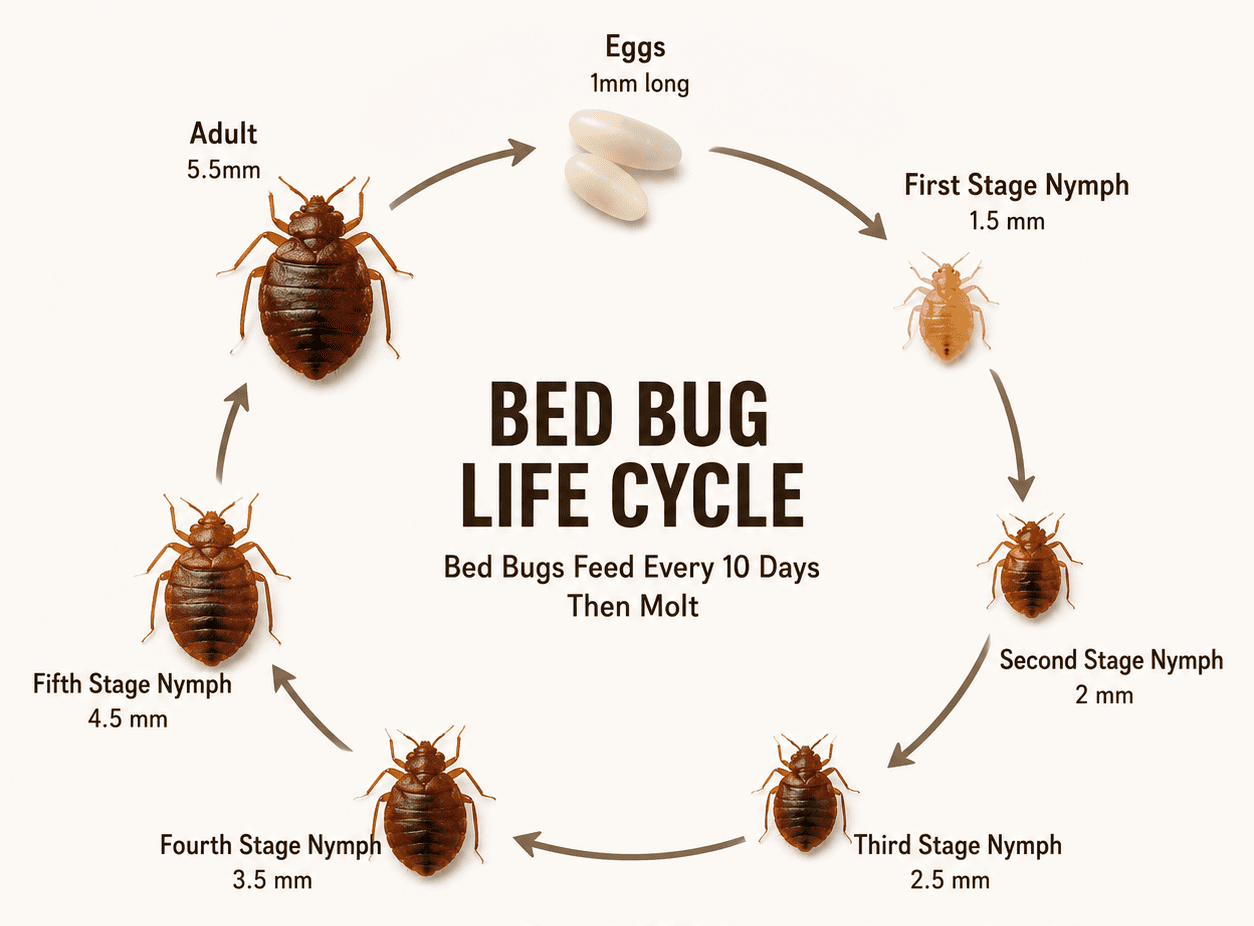
Bed bugs undergo incomplete metamorphosis (hemimetabolous development), meaning the young nymphs closely resemble miniature, lighter versions of the adults rather than going through a larval/pupal stage. The lifecycle progresses through distinct phases:
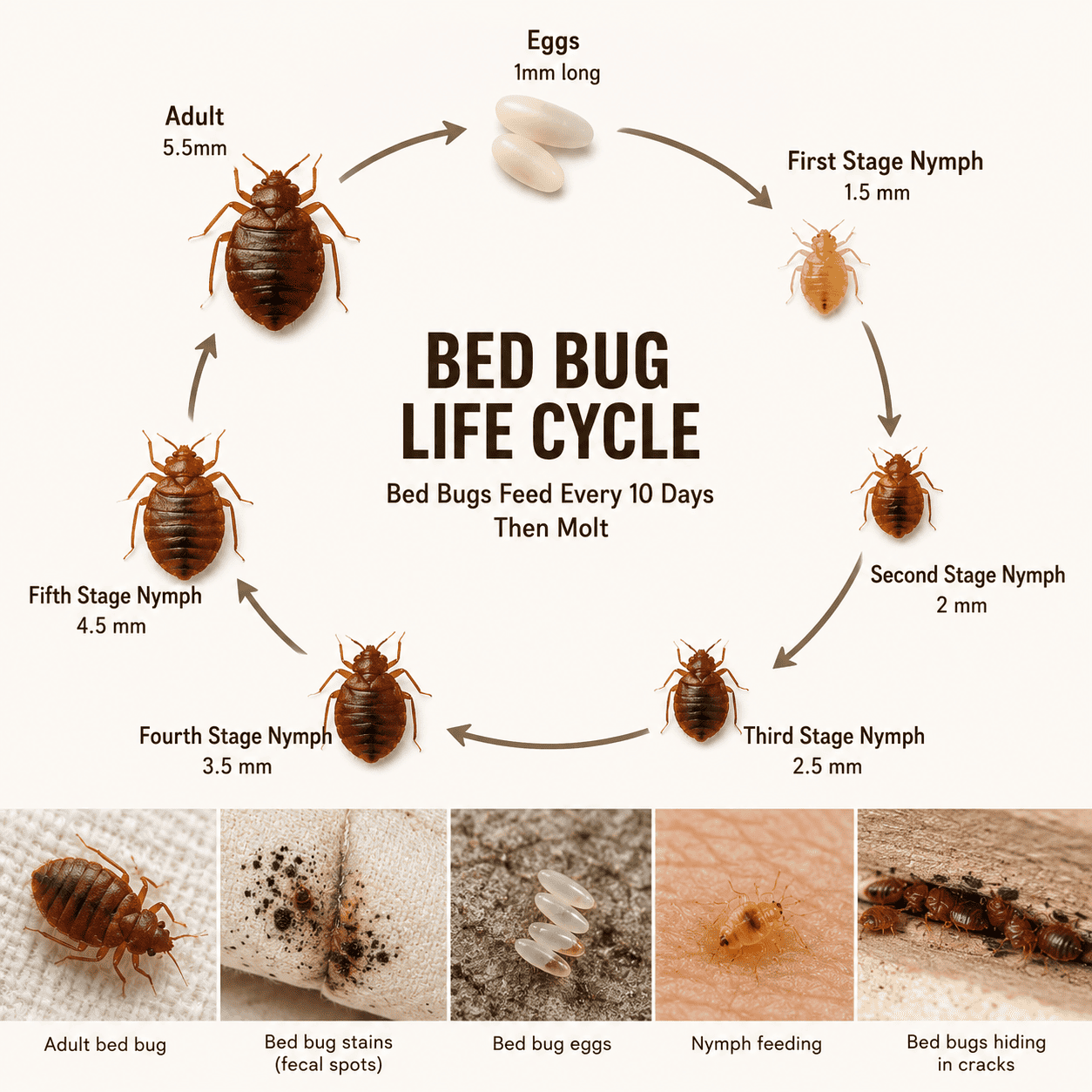 The Complete Bed Bug Lifecycle. Source: Bed Bug Barrier
Phase 1: The Egg
- Size & Appearance: Roughly 1 mm long, pearly white, and shaped like a tiny grain of rice.
- Deposition: Females use a sticky substance to securely cement eggs inside tight cracks, crevices, mattress tufts, and behind baseboards. A female bed bug can lay 1 to 5 eggs per day, and up to 200–500 eggs in her lifetime.
- Hatching: Under optimal room temperatures (around 21°C to 27°C), eggs hatch in 6 to 10 days.
Phase 2: The 5 Nymphal Stages
- Once hatched, the bed bug progresses through five distinct nymphal stages or instars to reach adulthood.
- The Blood Requirement: To transition and moult from one stage to the next, a nymph must consume at least one full blood meal. Without a blood meal, development halts.
- Moulting: After feeding, the nymph sheds its rigid outer exoskeleton (leaving behind a translucent "cast skin," which serves PCOs as a key diagnostic sign of a bed bug infestation). When ideal conditions prevail, each bed bug stage takes about a week with the nymphs growing from 1.5 mm in the first stage up to roughly 4.5 mm by the fifth stage.
Phase 3: The Adult
- Once the fifth moult is complete, the bed bug reaches sexual maturity.
- Mating: Bed bugs reproduce via a unique process called traumatic insemination, where the male pierces the female's abdominal wall to inject sperm. Such a driving reproductive urge among male bed bugs makes mated female bed bugs to migrate away from primary harbourage clusters to find quieter areas, establishing new satellite infestations throughout a structure.
- Lifespan: Adult bed bugs live for 4 to 6 months though in cooler conditions with lower metabolic rates, they can live up to a year or more without feeding.
Why the Bed Bug Lifecycle
Matters for Control
The rapidity of their multiplication and growth is why small bed bug infestations escalate into widespread crises so quickly. In ideal indoor climates, a bed bug can transition from an egg to a breeding adult in as little as 4 to 5 weeks.
Because unhatched eggs are naturally protected against many physical treatments and traditional insecticide applications, an understanding of this timeline highlights why long-term residual dusts, like amorphous silica dioxide, are so crucial. Amorphous silica dioxide remains active in crevices to intercept and eliminate newly hatched first-stage nymphs the moment they emerge.
The Crisis of Chemical Resistance in Bed Bug Control
Why Traditional Sprays Fail, and How Modern Integrated Pest Management (IPM) Restores Bed Bug Control.
Bed Bugs — The Resurgence of a Modern Super-Pest
The common bed bug (Cimex lectularius and Cimex hemipterus) is no longer just a nuisance, but a global public health and structural pest crisis. Over the past two decades, these blood-feeding insects have staged a massive global resurgence, infesting homes, five-star hotels, hospitals, and public transport.
The driving force behind this explosion is widespread resistance to insecticides used to control bed bugs. Decades of over-reliance on insecticide sprays to control bed bugs have backfired. Modern bed bug populations have mutated, developing thick outer shells and internal metabolic enzymes that shield them from traditional synthetic pyrethroid and neonicotinoid insecticides applied through pressurised spray equipment.
When pest control operators (PCOs) rely solely on insecticides to control bed bugs, they often end up scattering the bed bugs deeper into wall voids, leading to expensive, reputation-damaging callbacks.
The Proactive Solution: Integrated Pest Management (IPM) of Bed Bugs
To successfully eliminate resistant bed bug populations, the pest management industry must pivot away from reactive chemical spraying and adopt a strict Integrated Pest Management (IPM) framework.
IPM is a sustainable, multi-step strategy that combines deep biological knowledge, proactive structural proofing, continuous surveillance, and non-toxic physical elimination methods. By targeting bedbugs from multiple angles, IPM eliminates bed bug infestations safely without creating fresh insecticide resistance in their progeny.
Bed Bug Prevention Tips
Before a bed bug infestation occurs, physical exclusion and defensive habits are a good line of defence:
Inspect Travel Gear
When traveling, always check hotel mattress seams, headboards, and luggage racks for small reddish-brown spots or cast skins. Keep luggage elevated off the floor or bed.
Encasing Bedding
Install high-quality, bite-proof mattress and box-spring encasements. This seals off complex harbourages and makes any incoming bed bugs instantly visible on the smooth outer surface.
Clutter Reduction
Eliminate cardboard storage boxes and unnecessary clutter near sleeping areas, removing the tight, dark micro-spaces where bed bugs prefer to hide and lay eggs.
Laundering Protocols
Wash suspect bedding and clothing regularly at 60°C (140°F) or run them through a hot clothes dryer for at least 30 minutes to eliminate all bed bug life stages, including eggs.
Advanced Non-Toxic Bed Bug Control Methods
When a bed bug infestation is detected, an IPM program deploys highly targeted physical and mechanical control tools that completely bypass possible insecticide resistance:
Thermal Elimination via Steam Generation
Bed bugs and their eggs have absolutely no defence against extreme heat. Professional high-pressure steam generators deliver dry steam exceeding 80°C (176°F) directly into deep cracks, crevices, upholstery tufts, and baseboards. The intense heat kills all life stages on contact, acting as a highly effective, residue-free flushing and killing mechanism.
Surveillance via Pheromone & Interceptor Traps
Effective bed bug management relies entirely on accurate data about their presence and population levels. Modern bed bug monitoring uses passive pitfall interceptors beneath bed legs alongside highly specific bed bug pheromone aggregation traps. By emitting synthetic chemical cues that mimic natural bed bug harbouring signals, these traps draw bed bugs out of hiding and secure them in sticky zones, allowing PCOs to precisely map out the infestation and confirm the extent of control after a treatment.
Long-Term Residual Protection Against Bedbugs with Amorphous Silica Dioxide
While steam kills instantly on contact, it provides no lasting protection once the surface cools. This is where amorphous silica dioxide (SiO2) becomes the cornerstone of modern IPM.
Unlike chemical nerve toxins in insecticides, amorphous silica dioxide is a synthetic mineral dust that acts as a powerful desiccant. When bed bugs crawl through a microscopic layer of this dust, it static-clings to their bodies and physically absorbs the protective, waxy lipid layer from their exoskeletons. The clinging of silica dioxide to bed bug bodies triggers rapid, unavoidable dehydration and death within 24 to 72 hours.
Because silica dioxide acts physically bed bugs cannot develop biological resistance to it. Furthermore, as a stable mineral, it remains 100% active in dry, undisturbed wall voids and structural crevices indefinitely.
Upgrade Your Bed Bug Protocol
with Chinchex
As part of our commitment to sustainable, non-toxic pest prevention, Giridhar Pai Associates is proud to market Chinchex from Hong Kong, a premier high-purity amorphous silica dioxide formulation suitable for professional bed bug management. Chinchex is available in 50 gm squeeze bottles, 500 gm bulk packs, and high-penetration 500 gm pressurized aerosols — the ultimate tool to end resistance and eliminate callbacks for good.