
Introduction:
The Dual Threat to Food Safety: In the world of stored-product protection, few pests are as pervasive or economically damaging as the flour beetles of the genus Tribolium. Specifically, the Confused Flour Beetle (Tribolium confusum) and the Red Flour Beetle (Tribolium castaneum) represent a significant challenge for flour mills, bakeries, food warehouses, and retail environments globally.
While small in stature, typically measuring only 3 to 4 mm in length, their ability to contaminate vast quantities of product through waste, secretions, and physical presence makes them a top priority for food safety managers. This blog post delves into their intricate biology, the subtle differences between the two species, and the advanced monitoring technologies available to enable proactive defense.
Biological Profiles: Understanding the Enemy
To the untrained eye, these two beetles appear identical. However, understanding their specific traits are vital to effective Integrated Pest Management (IPM).
The Red Flour Beetle (Tribolium castaneum)
The Red Flour Beetle is of Indo-Australian origin and thrives in warmer climates. A defining characteristic of T. castaneum is its ability to fly, making it a highly mobile pest capable of infesting new areas rapidly. Physically, its antennae end abruptly in a three-segmented club, and the sides of its thorax are curved.
The Confused Flour Beetle (Tribolium confusum)
Named “confused” not because of its own behaviour, but because of the historical difficulty in distinguishing it from its red counterpart, T. confusum is more common in cooler, temperate regions. Unlike the Red Flour Beetle, the Confused Flour Beetle cannot fly. Its antennae thicken gradually toward the tip, forming a four-segmented club, and the sides of its thorax are more parallel.
Life cycle of the Flour Beetles
1. The Egg Stage: A single female can lay up to 400–500 eggs in her lifetime. These eggs are microscopic and coated with a sticky substance that causes flour particles to adhere to them, providing perfect camouflage within the food source.
2. The Larval Stage: Upon hatching, the larvae are creamy white to yellow and worm-like. They are “external feeders,” meaning they do not bore into whole grains but rather feed on dust, fines, and broken kernels. They undergo 5 to 11 moults before pupating.
3. The Pupal Stage: The pupae are naked (no cocoon) and transition from white to yellowish-brown. This stage is sessile, making it a critical window where thorough cleaning can remove future adult populations.
4. The Adult Stage: Adults are exceptionally long-lived, often surviving for six months to a year, or even longer under ideal conditions. This longevity allows for multiple overlapping generations within a single facility.
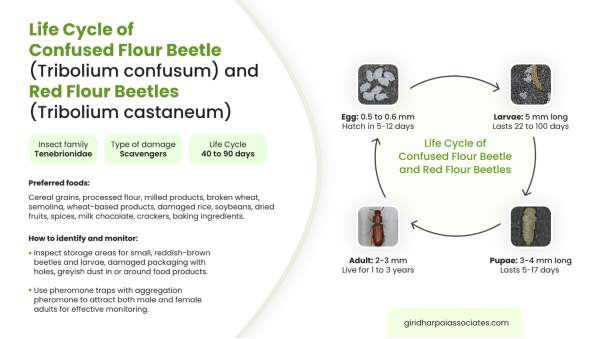
Lifecycle of Confused Flour Beetle (Tribolium confusum) and Red Flour Beetles (Tribolium castaneum)
The Lifecycle: A Race Against Time
Both species undergo complete metamorphosis: Egg, Larva, Pupa, and Adult. The speed of this cycle is highly dependent on environmental conditions, particularly temperature and humidity.
The Temperature Threshold: Environmental temperature is the primary driver of Tribolium population growth. The development time from egg to adult is roughly T ≈ 20 days at 35°C, but can extend to over 100 days at 22°C. Understanding this allows facilities to predict population spikes during seasonal transitions and adjust monitoring frequency accordingly.
Damage and Contamination: Beyond Simple Consumption
The primary damage caused by Tribolium species is not just the physical consumption of food but the chemically induced contamination that follows. These beetles possess specialised scent glands that secrete reactive chemicals called quinones. When populations reach a critical density, these secretions impart a pungent, disagreeable odour and a distinct pinkish tint to the flour or grain dust.
This chemical contamination renders the product unmarketable and can even affect the baking quality of flour. Furthermore, flour beetle presence increases the moisture content of the substrate through metabolic activity, which encourages the growth of moulds and secondary pests, leading to total product loss.
Proactive Monitoring: The Pheromone Advantage
Waiting to see a beetle in a bag of flour is a reactive strategy that often comes too late. Proactive management relies on “Early Warning Systems.” Pheromone monitoring is the gold standard for detecting low-level infestations before they become crises.
The Storgard CFB/RFB Quick Change Dome Master PCO Kit
At GPA, we advocate for the use of precision tools like the Storgard Quick Change (QC) Dome Trap. This system is engineered specifically for the crawling behavior of flour beetles.
Optimized Geometry: The “Dome” shape is designed to be low-profile, allowing beetles to easily climb the textured ramps and fall into the collection well. Unlike flat glue traps that can become dusty and lose effectiveness, the Dome protects the capture surface.
Broad-Spectrum Attractants: The kit utilises a highly purified aggregation pheromone that attracts both male and female beetles, providing a true representation of the total population rather than just one sex.
Kairomones: In addition to pheromones, the kit includes food-based attractants (kairomones) that appeal to the beetles’ hunger, significantly increasing the “trap catch” efficiency even in environments with competing food sources.
The “Quick Change” System: Professional maintenance is simplified. The Lure trays of the Quick Change traps can be swapped in seconds without the technician needing to handle messy lures, ensuring consistent performance and hygiene across the facility.
Strategic Trap Placement and Data Logging
Effective monitoring is as much about where you place the trap as what trap you use. We recommend a grid-based approach. Traps should be placed in “dead zones” where flour dust naturally accumulates, under processing equipment, near pallet racks, and along wall-floor junctions.
For flour beetles, traps must be placed on the floor or flat surfaces, as these insects spend most of their time crawling. By logging the number of beetles caught in each trap weekly, facility managers can create “heat maps” of activity, pinpoint the exact source of an infestation (such as a specific piece of machinery or an incoming shipment), and apply targeted treatments rather than broad-spectrum applications.
Take Control of Your Food Safety Today
Don’t let flour beetles compromise your brand’s reputation or your bottom line. Giridhar Pai Associates (GPA) is your trusted partner for high-performance, sustainable pheromone monitoring solutions.
Contact us today to source the Storgard CFB/RFB Quick Change Dome Master PCO Kit and implement a science-based monitoring program.