
In the global food processing and warehousing industries, Stored Product Insects (SPIs) are an unrelenting threat to product integrity, regulatory compliance, and brand reputation. Among these post-harvest pests, Cadra cautella, commonly known as the almond or tropical warehouse moth, stands out as an aggressive coloniser of dry agricultural products.
Found heavily across tropical and subtropical regions and frequently thriving in temperature-controlled environments within temperate zones, this lepidopteran pest targets a diverse range of high-value goods, including cocoa beans, chocolates, tree nuts, dried fruits, oilseeds, cereals, and milled grains.
For food safety managers and pest management professionals (PMPs), a reactive approach reliant on routine, blanket pesticide applications is no longer viable or compliant with modern food safety standards like BRCGS, FSSC 22000, and SQF.
True sustainability demands a transition toward green, proactive pest prevention. Achieving this requires a thorough understanding of the pest’s biological mechanisms and the deployment of targeted almond moth monitoring tools.
This blog post explores the biology, behaviour, and lifecycle of Cadra cautella, laying out the framework for its monitoring using the industry-standard Storgard II monitoring system with IMM+4 pheromone lures.
Almond moth – Taxonomy and Morphological Identification
To implement an effective Integrated Pest Management (IPM) framework, accurate morphological distinction in the pheromone trap is critical. Cadra cautella belongs to the family Pyralidae and the subfamily Phycitinae, a group notorious for infesting dry goods.
Adult Morphology of the Almond Moth
The adult moth is relatively small and inconspicuous, measuring approximately 7-10 mm at rest and with a wingspan of 11-20 mm. The forewings exhibit a dull, brownish-grey colouration interspersed with faint, darker transverse bands and a somewhat indistinct pale band across the inner third of the wing.
The hindwings are noticeably lighter, appearing semi-transparent or grayish-white with a darkened fringe along the margins. When resting, the moth holds its wings roof-like over its abdomen, adopting a narrow, streamlined profile that allows it to easily blend into dark pallet spaces, cracks, and structural crevices.
Larval Morphology of the Almond Moth
The destructive phase of Cadra cautella is exclusively larval. Upon eclosion, the larvae are microscopic and translucent white. As they feed and mature through successive instars, they attain a length of 12 to 14 mm. Their colour is highly variable and directly influenced by their dietary source, ranging from creamy white to light pink or distinct yellowish-grey tints.
A key diagnostic feature separating Cadra cautella larvae from other phycitine pests (such as the Indianmeal moth, Plodia interpunctella, which is not found in India) is the presence of distinct, darkly pigmented spots (pinacula) at the base of the body hairs (setae) along the abdominal segments, giving them a faintly speckled appearance under close magnification. The head capsule is a contrasting dark brown or reddish-brown, highly sclerotised to support powerful chewing mouthparts.
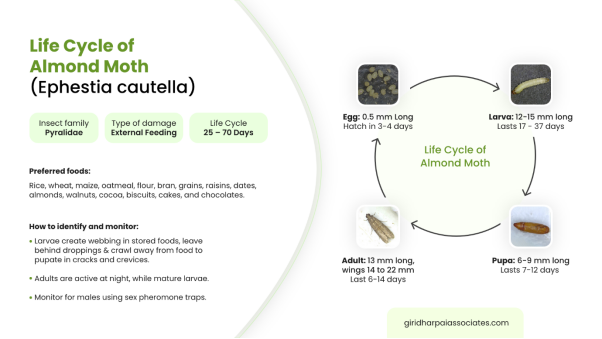
Life cycle of the Almond Moth (Cadra cautella)
The Lifecycle and Population Dynamics of the Almond Moth
Cadra cautella is a r-strategist characterised by rapid development, high reproductive output, and the capacity to exploit transient food resources. The speed of its developmental cycle is heavily dependent on ambient temperature and relative humidity (RH).
1. The Egg Stage of the Almond Moth
Following successful copulation, the female adult almond moth exhibits a highly developed oviposition behaviour, selecting sites close to potential larval food sources or directly on packaging seams and mesh bags. A single female can deposit between 150 and 300 eggs over her brief lifespan. The eggs are minutely small (approx. 0.3 to 0.5 mm), elliptical, and possess a finely reticulated shell. They are initially white or cream-colored, darkening slightly before hatching. Under optimal tropical warehouse conditions (30 °C and 70% RH), embryonic development concludes within 3 to 4 days.
2. Almond Moth Larval Stage and Webbing
Upon hatching, the first-instar larva immediately seeks out an entry point into the commodity, easily passing through woven polypropylene sacks, stitch holes, or minute imperfections in plastic packaging. Larvae feed aggressively on the germ of grains, nuts, dried fruits, biscuits, pasta, instant noodles, and cocoa, ruining far more food than they actually ingest due to contamination.
A major operational hazard associated with Cadra cautella infestation is its continuous production of silk webbing as it moves and feeds. Such silk binds food particles, frass (faecal pellets), and cast larval skins (exuviae) into a dense, foul mat. In food processing plants, this webbing builds up inside machinery, clogging gravity spouts, sifting screens, and electronic sorting systems. Almond moth webbing can cause unexpected production shutdowns and severe mechanical strain in food factories. The larval phase typically spans 5 to 6 instars over 18 to 25 days under optimal conditions. However, if temperatures drop below 15 °C, development slows significantly, or the larvae may enter facultative diapause to survive cold periods.
3. Almond Moth Pupation and Wandering Behaviour
When the final-instar larva reaches physiological maturity, it undergoes a distinct behavioural shift known as the “wandering phase.” It leaves the food matrix and migrates upward and outward to find a secure, dark pupation site. Larvae crawl out of bulk bags and internal storage zones toward wall-ceiling junctions, conduit boxes, pallet undersides, and structural cracks.
Once a suitable site is found, the larva spins a tough, protective silken cocoon inside which it transforms into a reddish-brown pupa. This pupal stage lasts 7 to 10 days under typical warehouse temperatures. Because these cocoons are often hidden deep within structural crevices, they frequently escape standard surface cleaning and contact pesticide treatments.
4. Almond Moth Adult Emergence and Reproductive Behaviour
Adult emergence occurs primarily during dusk or periods of low light, coinciding with the moth’s crepuscular and nocturnal activity patterns. Adult almond moths do not feed, and their sole biological objective is reproduction. Within hours of emergence, virgin females position themselves on vertical surfaces in a characteristic “calling” posture, raising their abdomens to release a highly potent sex pheromone that attracts males from downwind.
Almond Moth Monitoring: The Storgard II System and IMM+4 Lures
To prevent exponential almond moth population spikes, food processing facilities must move away from visually hunting for flying moths or observing webbing after the damage is done. Instead, they need a continuous, sensitive early warning system for almond moths. Pheromone monitoring exploits the pest’s chemical communication to capture male moths long before an infestation becomes visible to the naked eye.
The Science Behind the IMM+4 Pheromone Lure
The primary component of the sex pheromone emitted by the female Cadra cautella is Ephestia pheromone. The Trécé Storgard IMM+4 Pheromone Lure uses a precise, synthetically engineered matrix that mimics this natural volatile compound with exceptional fidelity.
What makes the IMM+4 lure highly effective is its broad-spectrum capability. It is carefully calibrated to release a controlled, stable plume of pheromones that simultaneously attracts several major phycitine moths, including:
- The Almond Moth (Cadra cautella)
- The Indianmeal Moth (Plodia interpunctella)
- The Mediterranean Flour Moth (Ephestia kuehniella)
- The Raisin Moth (Cadra figulilella)
- The Tobacco Moth (Ephestia elutella)
The lure’s advanced controlled-release polymer technology ensures a steady, reliable emission rate throughout its 6-to-8-week field life, avoiding the rapid fading or inconsistent scent plumes common to lower-grade alternatives.
The Storgard II Trap Architecture
The Storgard II trap design maximises catch efficiency for flying phycitine moths. Constructed from durable, heavy-duty paperboard coated with an optimised, non-drying sticky polymer, the Storgard II features a distinct tent or tunnel configuration. This design provides several operational advantages:
- Aerodynamic Flow: The open-ended tunnel structure allows air currents to pass smoothly over the internal IMM+4 pheromone lure, creating an unobstructed downwind attraction plume.
- Dust Protection: In food plants that handle flour, cocoa powder, or starches, airborne dust can quickly coat sticky traps, rendering them useless. The Storgard II’s canopy protects the inner adhesive layer from dust settling, preserving its catching power.
- Discreet & Secure: Captured insects are held out of sight inside the trap structure. Trapping almond moths through pheromone traps maintains a clean appearance during food safety regulatory audits and prevents caught insects from accidentally dislodging into passing product streams.
Strategic Almond Moth Trap Deployment and Grid Mapping
Simply hanging a pheromone trap in a warehouse does not constitute a monitoring program. Almond moth monitoring requires a deliberate, strategic deployment plan based on facility layouts and pest behaviour.
1. Placement Height and Location
Adult Cadra cautella moths are weak flyers compared to outdoor pests and tend to harbour in darker, low-airflow zones. Traps should be placed at a height of 1.5 to 2 meters above the finished floor level, coinciding with the adults’ primary flight zone and keeping them accessible for regular inspection.
Traps should be positioned near structural columns, pallet racking supports, and potential hazard areas such as processing equipment joints, ingredient storage bays, and packaging lines. Avoid placing traps near exterior doors, windows, or intake vents, as this can inadvertently draw outdoor moth populations into the facility.
2. Grid Density Guidelines
For effective baseline monitoring in standard warehousing environments, establish a uniform grid pattern with one Storgard II trap per 250 to 500 square meters of open space. In highly sensitive processing zones or areas containing high-risk commodities (e.g., cocoa roasting or nut sorting lines), increase the density to 1 trap per 100 to 150 square meters to quickly pinpoint small, localised infestations.
3. Data Logging and Action Thresholds
Traps must be checked on a strict, recurring schedule: weekly in active production facilities and bi-weekly in long-term raw material warehouses. Counts must be documented on a central monitoring log or digital tracking dashboard. Rather than relying on arbitrary “pesticide spray triggers,” facilities should analyse trends in almond moth counts over time. A sudden, statistically significant spike in weekly catch numbers (e.g., moving from 2 moths to 15 moths per trap within a week) indicates a localised breeding source or a contaminated incoming shipment, signalling the need for immediate, targeted inspection, deep cleaning, or product isolation.
The Sustainable Advantage of Proactive Monitoring
Integrating Storgard II traps and IMM+4 lures into a facility’s standard operating procedures provides a clear path away from reactive chemical treatments. By mapping catch data, QA teams can pinpoint where infestations are starting and address them with targeted sanitation, thermal treatment, or localised exclusion fabric. This targeted approach minimises product downtime, protects food from chemical residues, and ensures compliance with the strict standards of modern global food brands.
Secure Your Supply Chain with GPA’s Pheromone Monitoring Solutions
Don’t wait for product contamination or a failed audit to reveal a hidden almond moth infestation. Protect your raw materials, finished products, and facility reputation with premium, non-toxic monitoring solutions from Giridhar Pai Associates LLP.
GPA is your trusted technical partner and authorised distributor of authentic, industry-leading Trécé Storgard II Traps and IMM+4 Pheromone Lures across Asia. Our technical team is ready to assist you in designing a customised trap grid system tailored to your facility’s layout.
Contact GPA Today to Source Storgard II Traps and IMM+4 Pheromone Lures.
Email your inquiry to contact.gpa@giridharpaiassociates.com or use our website contact form to configure your proactive SPI monitoring framework.