
For decades, commercial facilities, food processing plants, hospitality venues, and pharmaceutical units have installed Insect Light Traps (ILTs) as a mandatory line of defence against filth flies. Yet, behind glossy product brochures and sales pitches, most ILT manufacturers and suppliers stay quiet about how these units really perform in day-to-day operations.
As India’s leading distributor of next-generation fly catchers and non-toxic pest management solutions, Giridhar Pai Associates LLP (GPA) believes in absolute transparency. Whether you are managing audit compliance in a food manufacturing plant or trying to rein in spiralling facility utility bills, here are the top 12 facts about ILTs that most brands keep hidden, and why technology has finally changed the game.
The Untold Realities of Insect Light Traps
1. The Technology Dates Back Over a Century
The earliest insect light traps, commonly termed “fly killers” or electrocuting grid traps, originated in the early 20th century. While industrial standards, building designs, and audit requirements have leapt into the digital age, millions of businesses still rely on a basic trapping concept engineered more than a hundred years ago.
2. Electrocuting Traps Explode Insects into Your Clean Air
Traditional “zappers” or electrocuting grid fly killers use high-voltage electrical grids to destroy insects. When an insect strikes the grid, the violent arc literally dismembers the body, creating an invisible aerosol of microscopic insect fragments, bacteria, and airborne pathogens that drift across clean surfaces, food preparation counters, and sensitive packaging areas, posing an unacceptable cross-contamination hazard.
3. Second-Generation Glueboard Traps Solved Fragmentation, Not Efficiency
Recognising the contamination hazards of zappers, the industry introduced second-generation ILTs: glueboard fly catchers. These capture flies silently and intact on an adhesive pad without explosive dismemberment. While this resolved the physical contamination risk, early glueboard units retained the core mechanical flaws of their predecessors: heavy, fragile glass fluorescent tubes and inefficient power circuits.
4. UV Fluorescent Tubes Deteriorate Fast
A standard UV fluorescent tube may continue glowing with a faint blue-purple light for a year or two, giving facility managers a false sense of security. Fluorescent tubes degrade quickly, losing about 10% of their essential UV output every month. By month 10, most fluorescent tubes emit virtually zero usable ultraviolet light in the spectrum needed to attract flying insects.
5. Fluorescent Traps Waste Enormous Amounts of Electricity
Standard commercial tube traps run two to three 15-watt fluorescent lamps around the clock, drawing 45W to 60W continuously when factoring in ballast inefficiencies. Across multi-unit corporate campuses, warehouses, and hotel kitchens running 24/7/365, this continuous draw translates into substantial, unnecessary power consumption and inflated utility overheads.
6. Reflected UV and Blue Light Drive Real Attraction
Filth flies (Musca domestica) and other flying pests aren’t attracted by raw brightness alone. Their compound eyes respond specifically to exact wavelengths within the UV-A and visible blue light spectrum. Traps designed without optical science or bio-enhancement coatings waste most of their light output and fail to lure flies from across large spaces.
7. Annual Tube Replacements Carry a Hidden Financial Penalty
Because fluorescent UV output drops to ineffective levels within 10 to 12 months, facilities are trapped in a perpetual cycle of buying replacement tubes. Procuring shatterproof fluorescent tubes year after year typically costs 10% to 20% of the trap’s original purchase price annually, silently inflating total cost of ownership (TCO).
8. High Breakdown Rates and Choke Failures
Traditional fluorescent traps depend on electromagnetic ballasts, starters, and electronic chokes. Subject to thermal fatigue and electrical surges, these components burn out frequently, causing unplanned downtime, maintenance callouts, and recurring spare-part expenses.
9. Energy-Efficient LED ILTs Are Proven Technology
Some conventional manufacturers suggest that LED fly traps are an untested novelty. Insect light traps using energy-saving light-emitting diodes (LEDs) have been deployed and proven across industrial facilities worldwide for over a decade.
10. LEDs Enable Sleeker, Safer, Compact Profiles
Fluorescent lamps require bulky, heavy housings to accommodate extended tube lengths, ballast gear, and protective cages. Solid-state LEDs let manufacturers design lightweight, slimline, aesthetically pleasing traps that blend into modern interior architecture without compromising coverage.
11. Up to 80% Lower Power Consumption
UV LEDs require only a fraction of the wattage to project insect-attracting light. Compared to conventional 45W or 60W fluorescent systems, advanced UV LED arrays slash operational electricity consumption by up to 80%, providing direct carbon-footprint reduction from day one.
12. Superior Catch Rates Over Fluorescent Traps
Extensive commercial testing confirms that modern LED fly catchers match and frequently outperform traditional fluorescent units. Combined with targeted optical spectra, their sustained, non-degrading UV output maintains peak catching performance for years, not months.
Meet the Solution: Pestroniks Innovations’ FLYght Duo
Understanding these industry pitfalls clarifies why forward-thinking facility managers, quality assurance heads, and sustainability officers are phasing out antiquated units.
To bridge the gap between uncompromising pest management and modern corporate standards, Pestroniks Innovations Pte. Ltd. delivers the market benchmark: the FLYght Duo UV LED Fly Catcher.
Table 1: A comparison of conventional fluorescent tube and FLYght Duo UV LED ILTs
| Feature | Conventional Fluorescent ILT | Pestroniks Innovations’ FLYght Duo UV LED ILT |
| Light Source | 2–3 x 15W Fluorescent Glass Tubes | 8 x 1W Glass-Free UV LEDs |
| Lamp Lifespan | ~5,000–8,000 Hours (< 1 Year) | 50,000 Hours (~6.7 Years) |
| UV Degradation | Loses ~10% UV Output Monthly | Stable, Continuous UV-A Emission |
| Power Consumption | ~45W–60W Continuous | 11W Maximum (80% Reduction) |
| Food Safety Hazard | Glass tubes risk shattering and contamination | 100% Glass-Free & Shatterproof |
| Insect Capture | Electrocution / Exposed glueboards | Concealed Universal Glueboard |
| Warranty | Standard 1 Year (Excludes Tubes) | 3-Year Replacement Warranty |
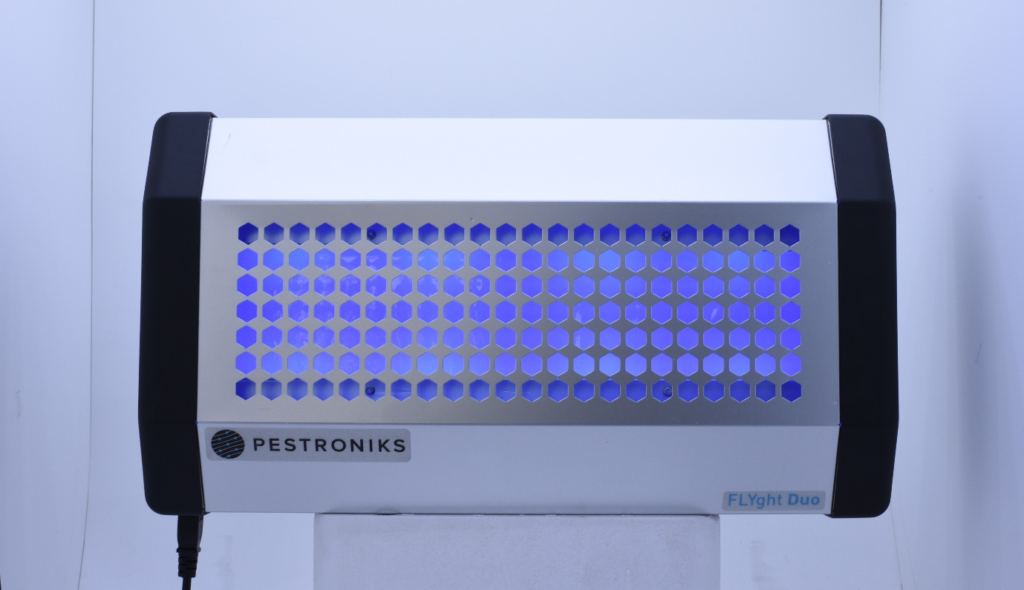
Pestroniks Innovations’ FLYght Duo UV LED Insect Light Trap
Built for Food Safety Standards and ESG Compliance
The FLYght Duo is engineered from the ground up to solve the stringent operational demands of modern enterprises:
- 100% Glass-Free Design for Strict Food Safety: Global food safety benchmarks (including BRCGS, IFS, FSSC 22000, and HACCP) demand strict glass-control policies in food handling, storage, and processing environments. Conventional traps carry fragile glass tubes that require plastic sleeving to mitigate breakage. The FLYght Duo uses solid-state, glass-free LED technology, eliminating the risk of glass contamination in production lines.
- Discreet and Hygienic Insect Catching: Unlike electrocuting zappers that fragment insects, or open traps that leave unsightly piles of dead flies visible to customers, the FLYght Duo utilises a concealed universal glueboard system. Trapped insects remain hidden from view, preserving food hygiene and customer perception of your brand.
- Patented Bio-VE+ Optical Attraction: To overcome the natural limitations of standard lighting, the FLYght Duo incorporates patented bio-VE+ (Bio-Visual Enhancer) technology. Mimicking visual attractant cues observed in carnivorous plants, this specialised bio-VE+ insert amplifies UV-A wavelength intensity and combines it with visible blue light, driving high housefly attraction rates across 50 to 80 square meters.
- Empowering Your ESG and Decarbonization Mandates: Environmental, Social, and Governance (ESG) criteria are no longer optional. Consuming only 11W maximum, the FLYght Duo cuts ILT power consumption by up to 80%. Because its LED light engine lasts for 50,000 hours without replacement (over 5 to 6 years of continuous operation), facilities eliminate the annual e-waste and mercury-disposal footprint associated with discarded fluorescent tubes.
- Universal Glueboard Architecture: Unlike competitors who lock customers into proprietary, high-margin glueboard refills, the FLYght Duo is built to accommodate cost-effective universal glueboards (418 mm × 283 mm), protecting your ongoing operating budgets.
Make the Smarter Investment for Your Facility
Continuing to operate legacy fluorescent insect light traps means accepting persistent lamp degradation, inflated power consumption, recurring tube replacements, and audit risks.
Upgrade your insect monitoring with the technology built for the modern enterprise. Choose the FLYght Duo to lower your total cost of ownership, advance your ESG goals, and secure audit-grade, glass-free food safety protection.
Contact us on our website to discuss your interest in the FLYght Duo, India’s leading UV LED fly catcher.