
In the world of stored product pests, few insects are as persistent or economically damaging as the cigarette beetle (Lasioderma serricorne).
Despite its name, this beetle is far from a one-trick pony because it is a cosmopolitan generalist that infests everything from spices and dried fruits to pharmaceutical products like drugs and upholstery.
For food safety managers and pest management professionals, understanding the biology of this beetle is not just academic; it is the first line of defence in protecting a brand’s reputation and bottom line.
Understanding the Enemy: Biology and Lifecycle
The cigarette beetle belongs to the family Ptinidae (formerly Anobiidae). To the untrained eye, it looks like a small, reddish-brown “c-shaped” speck, but under magnification, its unique features emerge.
Physical Characteristics
Adult cigarette beetles are approximately 2 to 3 mm long. They possess a distinct “humped” appearance because their head is tucked downward, nearly invisible when you view them from above.
One of their most defining features is their serrated antennae, resembling the teeth of a saw, which distinguishes them from the similar-looking drugstore beetle, which has clubbed antennae.
Crucial Identification Note: Unlike weevils, cigarette beetles do not have snouts. They are smooth-bodied with fine hairs that give them a slightly silky sheen.
The Lifecycle: From Egg to Adult
The lifecycle of Lasioderma serricorne is highly dependent on temperature and humidity. Under optimal conditions (around 30°C and 70% relative humidity), the cycle from egg to adult can be completed in as little as 40-50 days.
- The Egg: A single female can lay up to 100 eggs over her short adult life. These are deposited directly into the food source or in nearby crevices.
- The Larval (The Destroyer): The larva is the most destructive phase. The larvae are creamy white, scarab-like grubs covered in long hairs. They tunnel through products, feeding voraciously and leaving behind frass (excrement) and silk.
- The Pupa: As the larva matures, it creates a silken cocoon covered in bits of the food material. Inside the cocoon, the pupa metamorphoses into an adult.
- The Adult: Adults are strong fliers and are most active in low light or at dusk. Interestingly, adults do not feed on the stored products; their sole purpose is to find a mate and reproduce. However, their presence indicates an active infestation nearby.
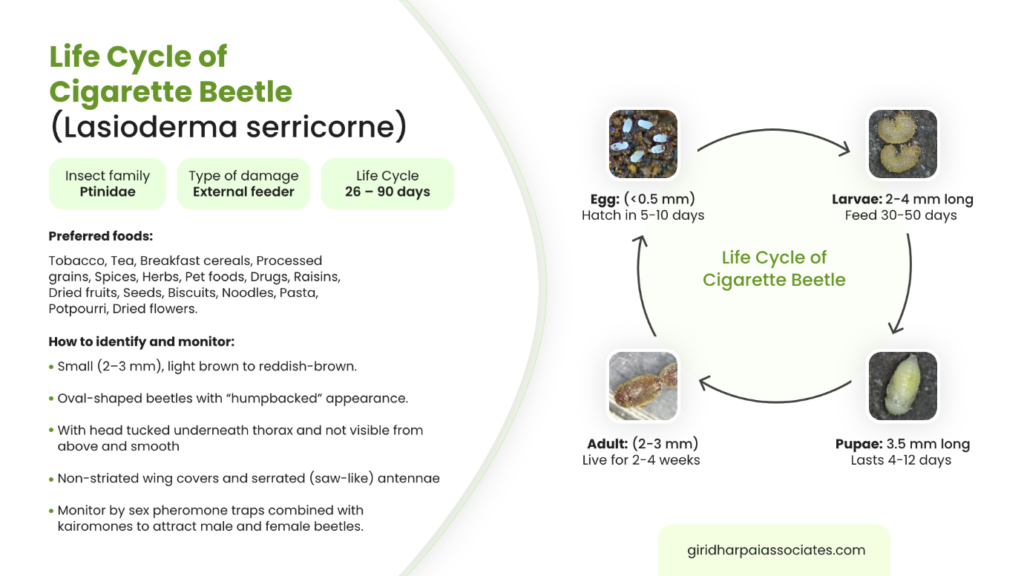
Life Cycle of the Cigarette Beetle
Why Detection Fails Without Pheromone Traps
Cigarette beetles are masters of concealment. Because the larvae feed deep within the product, whether it is a bag of turmeric, a box of cigars, or a pallet of cocoa beans, visual inspections often fail until the infestation is massive and a “breakout” occurs.
Waiting for “sightings” is a reactive strategy that leads to product recalls and financial loss. A proactive approach relies on pheromone traps. Pheromones are nature’s own communication system. By using a synthetic version of the female cigarette beetle’s sex pheromone (Serricornin), we can lure male beetles into traps, providing an early warning system that is active 24/7.
Precision Tools: Advanced Pheromone Monitoring Systems
At Giridhar Pai Associates (GPA), we promote the most scientifically rigorous tools available for stored-product insect management. Not all pheromone traps on the market perform equally well. The effectiveness of a pheromone monitoring program depends on trap design, pheromone purity, and placement.
1. Storgard CB+K Quick Change Dome Master PCO Kit
The Storgard Quick Change system by Trécé, Inc. is a gold standard in the industry. The “Quick Change” design is specifically engineered for ease of use in professional environments.
- Broad spectrum: The “CB+K” indicates it has a pheromone and a kairomone (food attractant) for attracting both male and female Cigarette Beetles, making it a versatile tool to increase the capture rate of both sexes
- The Dome Advantage: The low-profile dome design mimics the natural crevices beetles seek. It protects the pheromone lure from dust and debris, ensuring a consistent “plume” of scent.
2. Storgard Thinline III CB+K
For facilities where space is a premium or where traps need to be placed in tight spots (such as between pallets or along narrow shelving), the Thinline III is the preferred choice.
- Discreet Profile: Its slim design allows for placement in areas where traditional dome traps might be crushed or displaced.
- High Performance: Despite its size, it utilises the same high-purity pheromone technology as larger kits, ensuring sensitivity is not sacrificed for size.
3. Fuji Flavours New Serrico Trap
Coming from Japan’s leaders in pheromone technology, the New Serrico Trap is a masterpiece of precision engineering.
- Standardised Monitoring: These traps are world-renowned for their consistency. The pheromone release rate is tightly controlled to ensure that counts from one month to the next are truly comparable.
- Optimised Dimensions: The trap box is specifically designed (10 x 3.6 x 2.2 cm) to create an ideal aerodynamic environment for the pheromone to travel.
- Dual-Lure System: It typically uses a combination of a sex pheromone and a food-based attractant, ensuring maximum attraction even in competing environments (like a spice warehouse).
Implementing a Pheromone Monitoring Program
Monitoring is more than just “setting traps and forgetting them thereafter.” To truly manage cigarette beetles, GPA recommends a structured approach:
- Mapping: Create a floor plan and number every trap to allow for the creation of count data trends.
- Grid Placement: Place traps in a grid pattern, typically every 25–50 feet in open warehouses, with higher density near “hot zones” like receiving docks or processing areas.
- Regular Inspection: Check traps weekly or bi-weekly. A sudden spike in one trap indicates a localised infestation that can be treated before it spreads.
- Thresholds: Determine your “action threshold.” If a trap captures more than a specific number of beetles in a week, it triggers a deep-dive inspection of the surrounding stock.
The GPA Advantage: Proactive over Reactive
In the modern supply chain, there is no room for “spray and pray” pest control.
Sustainable pest management relies on high-quality data.
By utilising the Storgard and New Serrico pheromone trapping systems, you aren’t just catching cigarette beetles, but you are gathering intelligence about the environment you are monitoring.
At Giridhar Pai Associates, we don’t just sell traps but provide the technical expertise to help you interpret the cigarette beetle pheromone trap data. We understand the pest’s biology and the science behind the lure, ensuring your facility remains compliant with global food safety standards.
Don’t wait for your customers to find cigarette beetles in your product. Take control of your facility with the world’s leading pheromone monitoring technology.
Contact Giridhar Pai Associates (GPA) today to source authentic, high-performance cigarette beetle pheromone traps and start your journey toward proactive, green pest management.