
The global spice and grain industries are facing an unprecedented paradigm shift. Regulatory authorities, auditors, and increasingly conscious consumers are clamping down harder than ever on chemical pesticide residues in foods.
In a high-stakes market like export spice processing, relying purely on reactive, chemical-heavy pest control is no longer just a regulatory risk but an economic liability.
At my recent masterclass for the All India Spices Exporters Forum (AISEF) members in Maradu, on 22 July 26 I broke down how facilities can move away from high-cost, reactive chemistry and embrace a proactive, Integrated Pest Management (IPM) framework.
Here are the key strategic takeaways from that full-day training session.
1. Understanding the Enemy: Context, Scale, and Behaviour
Stored Product Insects (SPIs) are uniquely destructive. They are present at every single link of the supply chain: from the farm-gate, through the mills, warehouses, and processing plants, all the way to retail shelves and the consumer’s home.
The agricultural and economic impact is staggering: over 10% of global grain production is lost or damaged by SPIs annually. Crucially, contamination outweighs consumption. These pests spoil significantly more food than they eat by leaving behind webbing, frass, and insect fragments, leading to costly buyer rejections, recalls, and severe brand damage.
To manage them effectively, a facility must know that these pests are categorized based on their feeding biology:
- Internal Feeders: Larvae develop entirely inside whole grains (e.g., Rice Weevils, Lesser Grain Borers).
- External Feeders: Larvae chew through seed coats from the outside, heavily targeting high-protein and high-fat commodities like spices, nuts, and seeds (e.g., Cigarette Beetles, Almond Moths).
- Scavengers: Pests that cannot attack whole grains, relying instead on broken kernels, processed flours, and mill debris (e.g., Red and Confused Flour Beetles).
- Secondary Pests: Organisms that thrive exclusively on compromised, damp, or mouldy stock (e.g., Grain Mites, Psocids).
2. Deep Dive: Key Priority Pests in Indian Food Spaces
My training focused heavily on a few notorious species that processing plants encounter daily:
- The Cigarette Beetle (Lasioderma serricorne): A master external feeder that ravages whole spices like ginger, chilies, and paprika. They feature a distinct “humpbacked” shape, fly aggressively in low-light evening environments, and can complete an entire lifecycle in just 90 days, generating up to six overlapping generations a year in warm tropical climates.
- The Almond Moth (Ephestia cautella): A devastating nocturnal moth whose larvae produce dense silk webbing that binds food particles together and clogs heavy mill machinery. They thrive best in hot, humid environments (30–32°C, 70–80% RH).
- Flour Beetles (Tribolium castaneum & T. confusum): Red and Confused Flour Beetles are highly pervasive in milled products. While looking nearly identical, the flying Red Flour Beetle presents a significantly higher infestation risk across long distances. They secrete defensive compounds from scent glands that spoil flours with a highly disagreeable odor.
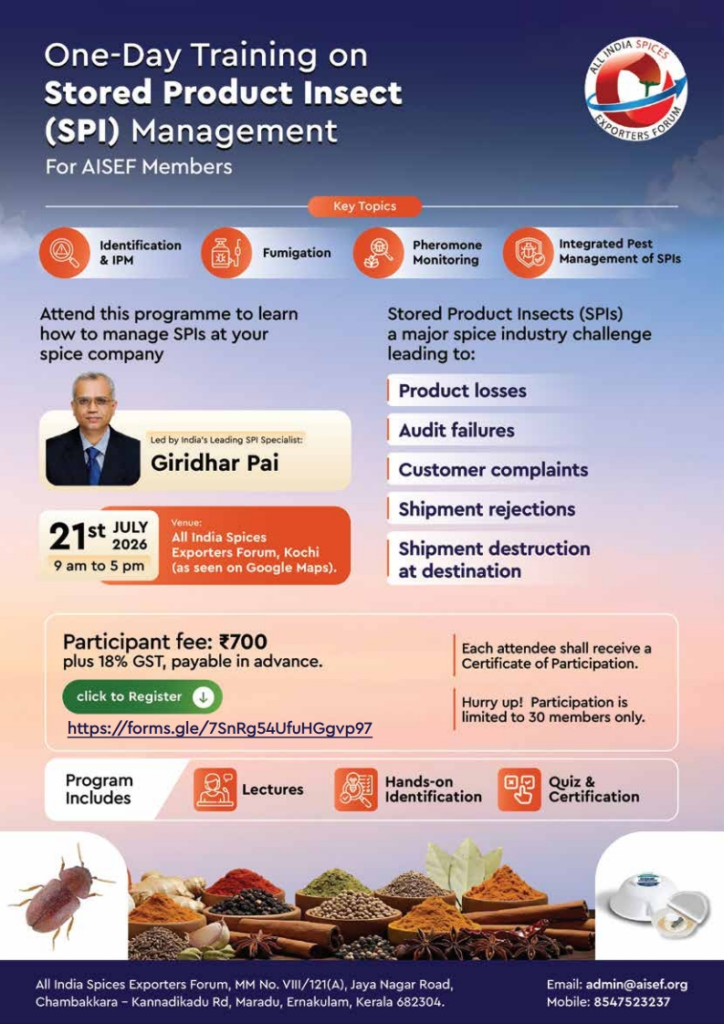
One Day Training Programme on Stored Product Insect (SPI) Management conducted by Giridhar Pai on 22 July 2026 for AISEF members at Maradu
3. Operational Sanitation and Environmental Engineering
The single most critical line of defense in any food or spice facility is rigorous operational sanitation. SPIs thrive in processing machinery voids, unused pipe dead-ends, and hidden structural corners where food dust, warmth, and humidity combine.
We advocate for a strong structural hygiene approach:
- The 1.5-Foot Pallet Rule: Never stack goods directly on the floor or flush against walls. Keep all stock elevated on pallets with at least a 1.5-foot (45 cm) gap from walls to allow adequate room for continuous cleaning, tracking, and inspection.
- Inbound Gatekeeping & Strict FIFO: Enforce 100% inspection of packaging integrity, age, and pest presence on arrival. Pair this with strict First-In, First-Out (FIFO) rules, as older product lots are prime targets for rapid pest colonization.
- Thermal Control Dynamics: Because insects are cold-blooded, you can weaponize temperature against them. Egg-laying drops off dramatically below 15°C, and flight completely stops below 12.5°C. Conversely, targeted heat treatments of 50°C for 2 hours or deep-freezing for 4–7 days effectively kill all lifecycle stages without altering chemical residue markers.
4. Demystifying Fumigation vs. Space Sprays
When localized sanitation fails and an active infestation takes hold, facilities frequently turn to heavy remedial treatments. However, understanding the physics of these tools is critical:
- Space Sprays (ULV Misting & Fogging): These are physical suspensions of fine liquid droplets that drop out of the air. They only settle on exposed horizontal surfaces and cannot penetrate packed pallets, bag cores, or dense spice commodities.
- True Fumigants (Gas): A true fumigant, such as Phosphine (), acts entirely as a true gas. It diffuses seamlessly through wood pores, cracks, and dense organic structures right into the respiratory spiracles of hidden insects.
Crucial Operational Warning: Phosphine is completely colorless and odorless in its pure form, the classic “garlicky” smell comes solely from deliberate formulation impurities. Never assume a space is safe because Phosphine’s garlicky odour is gone. Furthermore, Phosphine reacts aggressively with copper, brass, and precious metals, making strict containment maps vital to prevent the destruction of expensive mill electronics and control circuits.
5. The Gold Standard: Pheromone Monitoring Arrays
The most impactful shift an exporter can make is transitioning to a pheromone-based early detection system. Species-specific synthetic pheromones act as an “always-on” diagnostic network, catching low-level insect populations weeks before human eyes notice visible signs of structural damage.
During our masterclass, we highlighted the critical differences in trap setups:
- Sex Pheromone Traps: Target short-lived insects like the Cigarette Beetle and Almond Moth by mimicking female signals to draw in searching males.
- Aggregation Traps: Target long-lived beetles (like Flour Beetles) using aggregation compounds that attract both sexes.
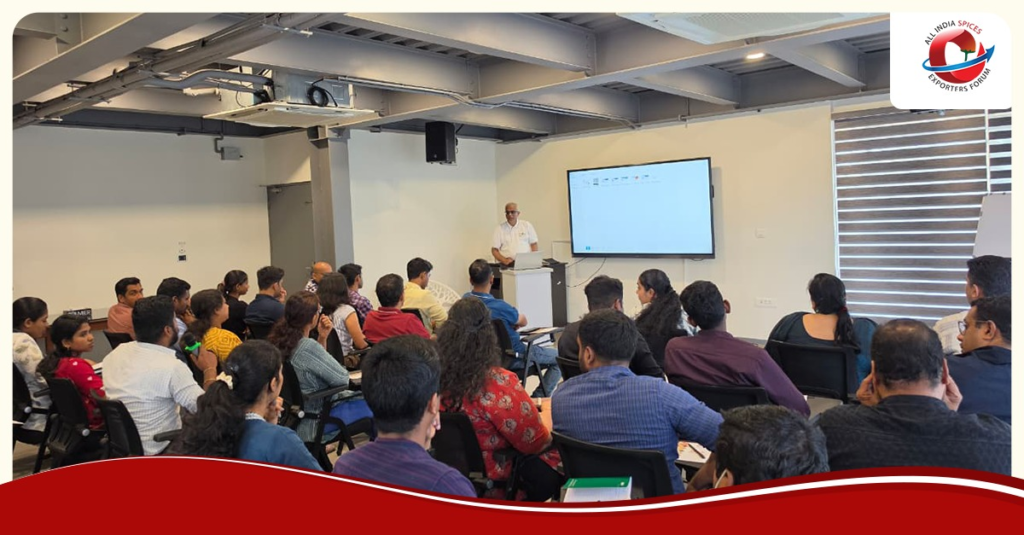
Giridhar Pai addressing the participants of the AISEF training on Stored Product Insect Management on 21 July 26
Avoid the “Top 5” Pheromone Trapping Pitfalls:
- Auditor-Only Trapping: Deploying traps right before an audit and removing them right after. Traps must be a permanent, year-round data collection tool.
- “Ghost Tracking”: Removing trapped insects from the sticky board during shifts to falsely show an artificial “zero count” to management. Meticulous record-keeping is the only way to model active population dynamics.
- Neglecting Lure Schedules: Forgetting to change pheromone lures at recommended manufacturer intervals (typically 4–8 weeks).
- Flawed Placement Geography: Placing traps directly in heavy air currents (which dissipates the pheromone plume too quickly) or right next to outside bay doors, which accidentally draws outdoor insects into your clean zone.
- Using Outdated Monitoring Tools: Relying on antiquated multi-part traps rather than modern, high-integrity physical solutions.
For Cigarette and Flour Beetle monitoring, the Storgard Quick Change (QC) Dome Traps stands as the definitive global gold standard. By combining both specialized sex pheromones and structural food attractants (kairomones) into a single, high-efficiency lure tray, the QC Dome Trap provides unmatched capture rates. Such dual-action design has made it the operational benchmark for major export-oriented spice processors and high-end manufacturers across India for over three decades.
Conclusion: Proactive vs. Reactive Realities
At the end of the day, managing storage pests isn’t about spraying down an infestation once your stock has already been compromised. Success is built upon a firm foundation of automated exclusion, structural deep cleaning, continuous pheromone grid auditing, and temperature alterations. Finding and mitigating a pest population early will always stand as the most profitable, compliant, and sustainable choice for modern food exporters.
For more information on setting up a pheromone monitoring grid or acquiring gold-standard trapping technologies like the QC Dome Trap range or other SPI pheromone traps and lures, reach out to us at Giridhar Pai Associates LLP. 📧 contact.gpa@giridharpaiassociates.com | 🌐 www.giridharpaiassociates.com
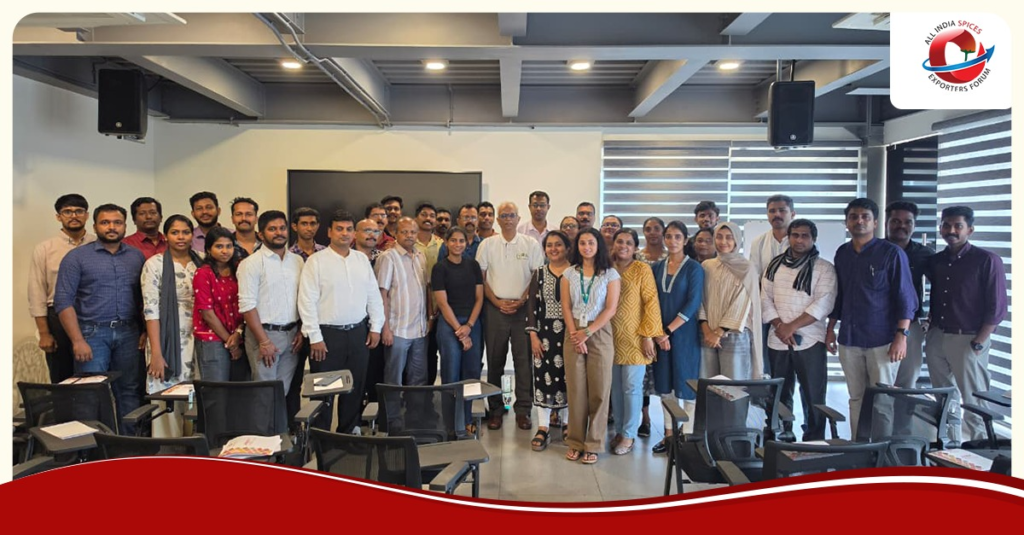
Participants of the AISEF one day training on Stored Product Insect Management with the trainer Giridhar Pai