
Victor Hugo wrote, “There is nothing more powerful than an idea whose time has come.”
Throughout technological history, whenever an innovation delivers a quantum leap in performance, economic efficiency, and practical convenience, the outgoing technology vanishes quickly:
- When electric incandescent bulbs proved their commercial viability, no amount of polish on gas mantles could save the gas lamp.
- When internal combustion engines rolled off automotive assembly lines, building faster, sleeker horse-drawn carriages became an exercise in futility.
- Today, automotive engineering is shifting rapidly toward electric vehicles (EVs).
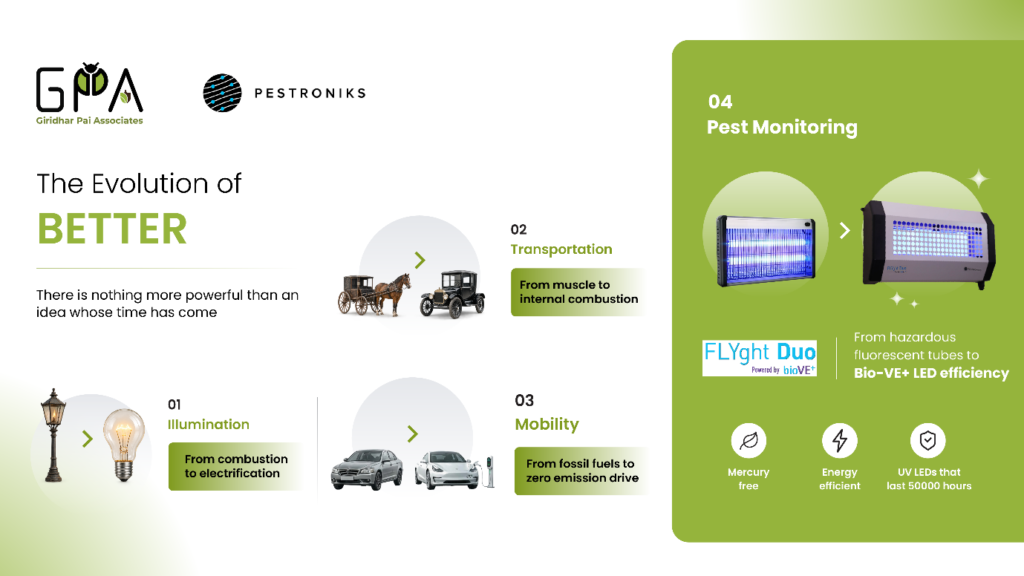
Illustration of the Inevitable Leap from fluorescent tube insect light traps to FLYght Duo
Industrial fly management is experiencing that identical turning point.
The conventional ultraviolet fluorescent tube (UV FT) insect light trap (ILT), which was a standard fixture on production floors for decades, has reached the end of its technological lifecycle.
The era of high-efficiency UV LED ILTs has arrived.
The Flaws of Yesterday’s UV Fluorescent Tube ILTs
For years, commercial food processing facilities, pharmaceutical manufacturing units, and commercial kitchens relied on fluorescent tube ILTs as their standard flying-insect monitoring tool. While they served a purpose, they brought significant operational drawbacks:
- Steep Degradation of UV Emission: Fluorescent UV tubes lose effective insect-attracting irradiance within 6 to 9 months, even while continuing to glow visibly to the human eye. The imperceptible degradation of UV emission from fluorescent UV tubes leads to silent monitoring failures unless you systematically replace degraded UV tubes.
- Recurring Maintenance Overheads: Replacing UV fluorescent tubes once or twice every year across dozens or hundreds of traps creates recurring procurement, labour, and downtime costs.
- Energy Inefficiency: Fluorescent ballasts draw substantial continuous power, which is an unwanted expense in 24/7 operating facilities seeking to shrink their carbon footprint.
- Hazardous Waste Compliance: UV fluorescent tubes contain mercury vapour, requiring specialised disposal workflows to prevent chemical contamination and audit violations in food-grade or pharmaceutical environments.
The Breakthrough: Pestroniks Innovations & Bio-VE+ Technology
When Giridhar Pai Associates LLP (GPA) introduced Singapore’s Pestroniks Innovations Pte. Ltd.’s FLYght traps to the Indian market in 2020, pest controllers and user industries viewed UV LED fly control with scepticism.
Early market scepticism centred on whether LEDs could match the wide-spectrum attractancy of conventional fluorescent UV tubes.
The FLYght Duo answered that question through proprietary optical engineering: Bio-VE+ (Bio-Visual Enhancer) technology.
Unlike generic LED fixtures that shine a directional beam, Bio-VE+ optimises the emission wavelength and scatters light specifically to target the visual receptivity of target flying insects, filth flies.
The advantages of the FLYght Duo over old fluorescent tube ILTs are immediate:
- Extended LED Lifespan: Up to 5 years and more sustained attractancy output, eliminating frequent replacement cycles through their 50000-hour lifespan.
- Substantial Power Reductions: Cuts electrical consumption by more than half compared to dual 30 W or triple 45W fluorescent tube ILTs.
- Mercury-Free, Audit-Ready Design: Zero mercury and glass hazard concerns, making it directly aligned with HACCP, BRCGS, and ISO 22000 standards.
- Enhanced Catch Retention: Paired with glueboards designed to preserve insect specimens intact for accurate count-and-trend identification under non-toxic IPM protocols.
When Customers Become the Strongest Advocates
When an innovation truly works, adoption moves from marketing push to market pull.
Over the past few years, the biggest advocates for FLYght Duos have been Quality Assurance leaders, hygiene heads, and facility managers across India.
When these professionals move to head operations at new plants or facilities, they often specify the FLYght Duo on day one.
Today, procurement conversations rarely ask, “Will UV LEDs attract flies?”
The field-proven efficacy is already established.
Instead, conversations focus on volume supply, retrofitting existing footprints, and standardising across multi-site manufacturing hubs.
UV Fluorescent tubes are destined for the history books.
Continuing to buy replacement UV fluorescent tubes is simply investing in obsolete technology.
Ready to Upgrade Your Insect Monitoring Program?
Don’t let outdated, energy-draining UV fluorescent tube traps compromise your facility’s pest prevention audits or sustainability targets.
Switch to the FLYght Duo UV LED Trap today.
- Zero Mercury Liabilities
- Dramatic Energy Savings
- Field-Proven Bio-VE+ Attraction
Contact Giridhar Pai Associates LLP, India’s specialist distributor for non-toxic, innovative IPM monitoring systems like the FLYght Duo.